
🃏
2048 Game Guide: How to Play and Win
2048 is a 4x4 sliding puzzle - merge matching number tiles until you reach the 2048 tile. This guide covers the rules, corner strategy, and tips.
▶️ Play Now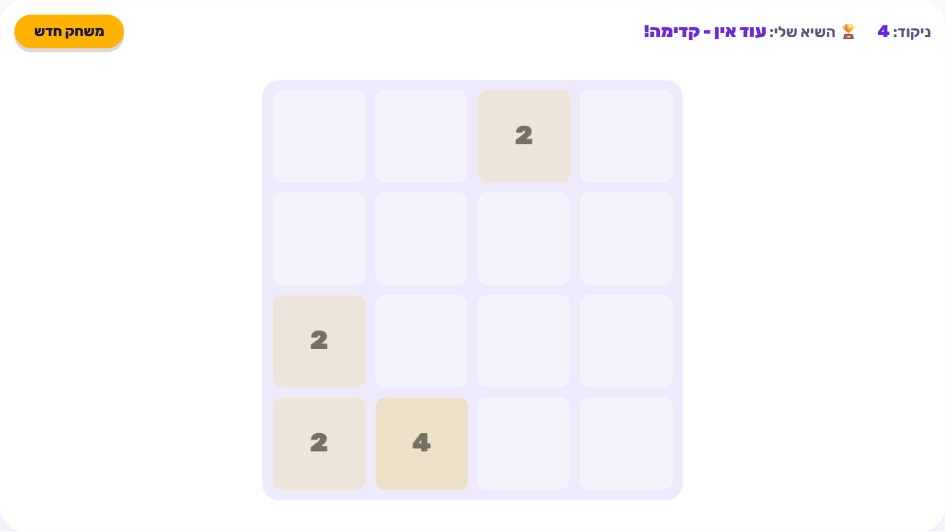
🎯 How to play
- Slide every tile on the board up, down, left, or right - with the arrow keys or a swipe on a touchscreen.
- When two tiles with the same number collide during a move, they merge into a single tile worth double.
- After every move, a new tile appears in an empty spot on the board - usually a 2, and sometimes a 4.
- Keep merging tiles to build bigger numbers, step by step, until you reach a single tile worth 2048.
- Watch the board fill up - if no move in any direction can still create a merge, the game ends.
Where does 2048 come from?
2048 isn’t an old classic like chess or checkers - it’s a genuinely young game, born in March 2014, when a young Italian developer named Gabriele Cirulli built it as a personal side project over a single weekend. He didn’t invent the idea from scratch: 2048 is a polished, open-source take on an earlier game called “1024,” which itself was built on the merging concept from “Threes!,” a mobile game that had come out shortly before. Cirulli took the idea, simplified it, published the full source code on GitHub for free, and put it online with no ads and nothing to install.
What happened next is well-documented internet history: the game spread across the web at an astonishing pace within days. Tech news sites wrote about it, people shared links with friends, and within about two weeks, millions of people around the world were already playing. Because the code was fully open, anyone could take it and build their own version - which is exactly why there are so many different versions of 2048 scattered across the internet today, in different colors, different themes, and sometimes slightly different rules. The version on this site is our own independent implementation of that same classic idea - free, with no sign-up, and with no connection or partnership with any other site running its own 2048 clone.
How to play - the basic rules
The 2048 board is a fixed 4x4 grid - 16 tiles, no more and no less, and there are no difficulty levels that change that. On every move you pick one of four directions: up, down, left, or right. Every tile on the board slides together in that direction until it hits the edge of the board or another tile.
The magic happens when two tiles with the exact same number collide during that move: they merge into a single tile worth double the value of the two originals. A 2 tile meeting another 2 becomes a 4. Two 4 tiles become an 8. And so on, doubling after doubling, until you reach - this is the game’s official goal - a single tile worth 2048.
It’s worth understanding that you never choose which specific tiles to merge. You only choose a direction, and every tile on the board moves together according to that choice. After each move that actually changes the board, one new tile appears in a random empty spot - the overwhelming majority of the time (90%) it will be worth 2, and less often (10%) it will be worth 4. Knowing that ratio matters a lot for planning, since a 4 tile “costs” more empty spaces to merge away than a 2 does.
Your score builds up throughout the game: every time you merge two tiles, the value of the newly created tile gets added to your running score. Merging two 8 tiles (which become a 16) adds 16 points to your total, not just “one point.” Your best score is the highest score you’ve ever reached. The game ends when the board is completely full and no move in any direction would create a merge - in other words, when no two adjacent tiles anywhere on the board share the same value.
The corner strategy - the method every strong player learns
If there’s one technique that anyone who plays 2048 seriously picks up fast, it’s what’s known as the corner strategy. The idea is simple to explain, but it takes real discipline to actually follow: you pick one corner of the board - say, the bottom-left corner - and commit to keeping your highest-value tile locked there, never letting it move.
Around that giant anchor tile, you build a row or column of descending values: right next to the biggest tile, the second-biggest; next to that, the third-biggest; and so on - like steps leading down from the strong corner toward the center of the board. This layout is sometimes called a “snake pattern,” because if you trace an imaginary line from the biggest tile down to the smallest, it winds across the board like a snake.
To hold that pattern together, strong players almost never use the one direction that would pull the biggest tile out of its corner. If your anchor corner is bottom-left, for example, you’ll try to avoid moving upward, since that move risks “freeing” the big tile from its corner and scattering the order you’ve built. Instead, you work with the other three directions as needed, saving the forbidden direction for the rare moments when you genuinely have no other legal move.
The payoff of this method is that it turns a messy board into something you can actually read at a glance: you always know exactly where your biggest tile sits, and you always know which tiles make sense to merge next to keep extending the descending order. Beginners tend to slide in every direction without any real plan, and quickly end up with a board full of scattered, awkward numbers that are hard to merge - which is the main reason games end early.
Common mistakes that get you stuck
A handful of habits show up again and again in games that stall out long before reaching 2048:
- Breaking corner discipline too soon. The moment you move in the “forbidden” direction without a real need, it’s easy to lose the descending order you’ve carefully built, and you end up rebuilding it almost from scratch.
- Merging on impulse. Taking an easy merge right now that wrecks the order of the bigger tiles next to it is a short-term win that costs you a few moves later.
- Ignoring your second-biggest tile. Players focus only on the biggest tile and forget to also keep a fixed spot for the second-biggest one - without that, the “snake pattern” falls apart fast.
- Panicking when the board fills up. With only one or two empty spots left, it’s tempting to make a random move out of pressure. That’s exactly the moment to pause and check which directions still leave the board in a sensible order.
Real tips for beginners
- Plan before you move, not after. Try to picture how the board will look after a slide before you actually make it - that’s the difference between a player who reacts and one who plans.
- Don’t chase every possible merge. Sometimes skipping a small merge is better for keeping the overall board order intact than merging everything you can, whenever you can.
- Look at the whole board, not just your corner. It’s easy to fixate on the big tile in the corner and forget the other side of the board is filling up with small, scattered tiles in the meantime.
- Practice the three-direction habit until it’s automatic. Once your hand “remembers” which direction to avoid by default, it’s much easier to focus on the decisions that actually matter.
- Don’t get discouraged by an early game-over. Every game starts from a completely empty board with nothing but 2s and 4s - even the highest scores were built tile by tile, not in one leap.
Many versions of 2048 exist online - what’s here
Because Cirulli’s original code was fully open source, dozens if not hundreds of different 2048 versions have been built over the years across the web - some nearly identical to the original, others with their own themes, colors, or extras. Well-known sites like Brainzilla, for example, run their own version of 2048, just like many other game sites do. That’s a natural part of this game’s history: it was born as an open-source project specifically so anyone could build on it.
The version on this site is our own independent implementation - with no partnership or connection to any other site running its own 2048. It sticks carefully to the original, exact rules: a 4x4 board, the same 90/10 ratio between 2 and 4 tiles, and the same scoring math. What makes it its own is that it runs right in the browser with no sign-up, keeps track of your personal best score, and awards a special “2048 Champion” avatar the first time you get any single tile to reach the value 2048.
Similar games on the site worth trying
If you enjoyed the logical challenge of 2048, check out Tetris - a classic falling-blocks game that demands fast spatial planning, a different style but the same feeling of “arranging the board just right.” If you like moving tiles around to build order out of chaos, try Sliding Puzzle, which uses that same tile-sliding principle to reach a goal. And if you’re after a completely different kind of memory challenge, Memory Game trains visual memory instead of number planning, and fits the same crowd that loves short, addictive thinking games.
🧠 Test Yourself
Answer all three questions correctly to earn 100 stars!
Frequently Asked Questions
Is the 2048 game free to play?
Yes, it's completely free, runs right in your browser, and there's no sign-up or download needed to play.
How big is the 2048 game board?
The board is a fixed 4x4 grid - 16 tiles in total. There are no difficulty levels that change the grid size; the challenge grows as the numbers on the board grow.
What are the odds that a new tile will be a 2 or a 4?
After every move, one new tile appears: it's a 2 about 90% of the time, and a 4 the other 10%. It's random, but worth knowing when you're planning your next move.
Are there other versions of 2048 online, like on Brainzilla?
Yes - because the original 2048 was open source, many sites built their own versions, Brainzilla included. This is our own standalone, free implementation of the classic rules, with no affiliation to any other site.
When exactly does the game end?
The game ends when the board is completely full (all 16 tiles occupied) and no move in any direction would create a merge - meaning no two adjacent tiles anywhere share the same value. As long as one legal move remains, you can keep playing.