
🃏
Sliding Puzzle Game: How to Play and Win
Sliding Puzzle: a classic 4x4 tile puzzle with 10 photos that unlock one by one. Rules, a real solving method, and the puzzle's surprising history.
▶️ Play Now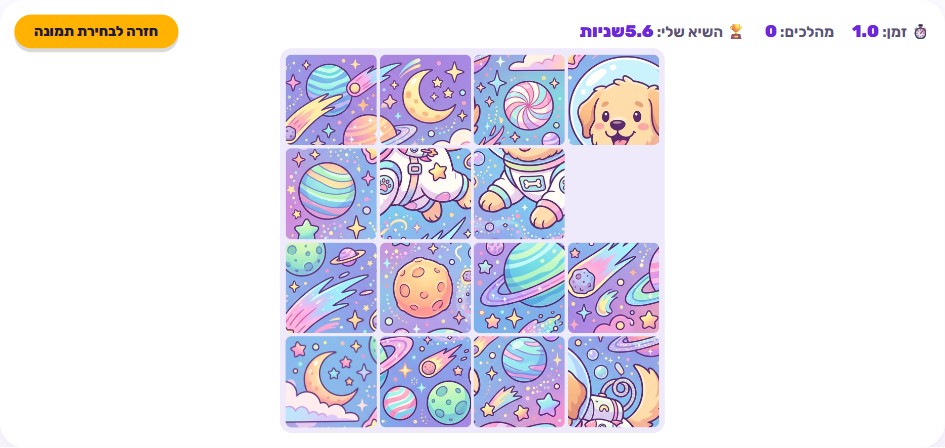
🎯 How to play
- Pick one of the photos you've already unlocked - like the puppy or the koala.
- Click a tile next to the empty slot to slide it into that open space.
- Keep sliding tiles one at a time, row by row, until the picture is complete.
- Watch the timer and the move counter - both of them decide your score.
- Finish the puzzle to unlock a new photo for your next round.
- Come back to a photo you've already solved and try to beat your best time and move count.
Where this famous puzzle comes from - a bit of history
A sliding puzzle with one empty slot - known around the world as the “15 Puzzle” - is one of the oldest, most thoroughly documented puzzles there is. Its original form, a 4x4 board with 15 numbered tiles and one empty space, became a genuine worldwide craze around 1880 in the United States. Some accounts credit a postmaster named Noyes Chapman as the original inventor, but the person who truly turned it into a mass phenomenon was the famous puzzle maker Sam Loyd, who offered a huge prize (1,000 dollars, a fortune at the time) to anyone who could solve one specific starting arrangement - an arrangement that can be mathematically proven to be unsolvable. Exact historical accounts differ on some of the details, since this all happened more than 140 years ago, but the fact that the craze was real, the prize was real, and thousands of people genuinely tried to solve the impossible, is well documented. This simple puzzle, needing nothing more than a handful of plastic or wooden tiles, managed to take over offices, schools, and homes across America and Europe within a few months - not unlike how a viral app takes over phones today.
How the game works on our site
Our digital version stays true to the original rule set: a 4x4 board, meaning 16 slots in total - 15 tiles carrying pieces of a picture, and one empty slot. Instead of numbers, each tile shows a piece of a real, cute photo, and there are 10 different photos to choose from: a puppy, koala, teddy bear, dolphin, butterfly, rainbow, owl, penguin, lion, and parrot.
Here’s something worth knowing up front: not all 10 photos are available right away. You start with just one, and once you solve it, another one unlocks (up to two ahead at any given time), and so on until all 10 are eventually available. That gives the game a real sense of progression - every photo you solve isn’t just a win on its own, it’s also the key to the next one.
Every solve tracks a running timer and a move counter that counts every tile you slide. Together, those two numbers decide your score: the game calculates it as max(15, round(110 - seconds×1.2 - moves×0.3)) - meaning both speed and move efficiency improve your score, so you can’t “game” the system with pure speed and no efficiency, or the other way around. Your personal best is tracked separately per photo, so you can always return to a photo you’ve solved before and try to beat your time or your move count.
A surprising math fact: not every arrangement can be solved
Here’s a fact that surprises almost everyone the first time they hear it: mathematically, exactly half of all possible random starting arrangements of a classic 15-puzzle are completely unsolvable - no matter how many moves you try. This isn’t a matter of difficulty or opinion; it’s a proven fact rooted in a branch of math called permutation parity. Every possible arrangement of the tiles belongs to one of two “families,” and one of those families simply cannot be reached from the solved state, no matter how you slide the tiles. This is exactly why Sam Loyd’s historical prize was a safe bet - he deliberately chose a starting arrangement from the impossible family.
The good news: you don’t need to worry about any of this in our game. Every time the game generates a new starting arrangement, it’s built so that it’s always solvable - instead of rolling a completely random layout and hoping for the best, it scrambles the picture using a sequence of legal slides starting from the solved state, so a path back always exists. You can push as hard as you want, fully confident that a solution is out there.
Real tips for solving it systematically
Experienced solvers don’t “guess” their way through a sliding puzzle - they work through it in a fixed method, layer by layer:
- Start with the top row. Find the tiles that belong in the top row, place the two corner tiles for that row first, then slide the rest into position. Once the top row is correct, don’t touch it again.
- Move on to the left column. Same method - find the tiles that belong in the left column (below the row you already locked in) and slide them into place without disturbing what’s already solved.
- Build the picture layer by layer, working inward. After the top row and left column, apply the same idea to the second row and second column, and the picture “closes in” from the outside toward the center.
- Save the last 2x2 corner for last. The final four tiles in the bottom-right corner always feel the most frustrating, because every move seems to undo what you just solved. The trick is patience: there’s a fixed sequence of slides that solves exactly that corner without touching the rest of the board, and after a few tries it becomes automatic.
- Don’t be afraid to temporarily “break” a solved piece to make progress. Sometimes getting one tile into its correct spot means briefly moving another tile that’s already close to its own place - that’s a normal part of the process, not a mistake.
- Practice on the earlier, smaller-numbered photos first. Once the method is second nature, your time and move count drop dramatically on every photo after that.
The “Sliding Puzzle Champion” avatar - how to unlock it
The site has a special achievement called “Sliding Puzzle Champion”: to earn it, you need to solve any one of the puzzle photos (it doesn’t matter which, and you don’t need to unlock all 10) in under 30 total moves. This has nothing to do with how many photos you’ve unlocked or how long it took you - it’s a pure efficiency measure: how few tiles you had to slide to reach the complete picture. The layered method described above is exactly the way to get there - a player sliding tiles without a plan usually needs well over 30 moves, while a player who’s mastered the method can easily drop below that threshold, especially on a photo they’ve already solved a few times and know well.
Similar games on the site worth trying
If you enjoyed the thinking challenge of Sliding Puzzle, check out Memory Game - a completely different kind of visual memory challenge, where instead of sliding pieces you flip cards and look for matching pairs. If you like planning moves ahead, you’ll enjoy 2048, where every move merges tiles and builds a long-term strategy in much the same spirit as Sliding Puzzle. And if you want a different kind of thinking challenge - navigation instead of assembly - Maze is a great one to try next.
🧠 Test Yourself
Answer all three questions correctly to earn 100 stars!
Frequently Asked Questions
How many photos does Sliding Puzzle have?
There are 10 different photos in total - a puppy, koala, teddy bear, dolphin, butterfly, rainbow, owl, penguin, lion, and parrot. They're not all unlocked from the start; they open up gradually.
How do I unlock new photos?
You start with just one photo unlocked. Every time you solve a photo, another one unlocks (up to two ahead at once), until all 10 are eventually available to pick from.
Do I need to download anything to play?
No, there's nothing to download. The game runs right in your browser on the site - no install, no sign-up, just open it and play.
How do I unlock the 'Sliding Puzzle Champion' avatar?
Solve any one of the puzzle photos - it doesn't matter which - in under 30 total moves. It has nothing to do with unlocking all 10 photos; it's purely a measure of how efficiently you solved that single puzzle.
How is my score calculated on each solve?
Your score depends on both speed and move count - the faster you solve it and the fewer moves you use, the higher your score. Your personal best is tracked separately for each photo.