
🃏
Tic-Tac-Toe Guide: Tips vs the Computer
Tic-Tac-Toe here is played against the computer on a classic 3x3 board. This guide explains how the computer decides its moves and the Champion badge.
▶️ Play Now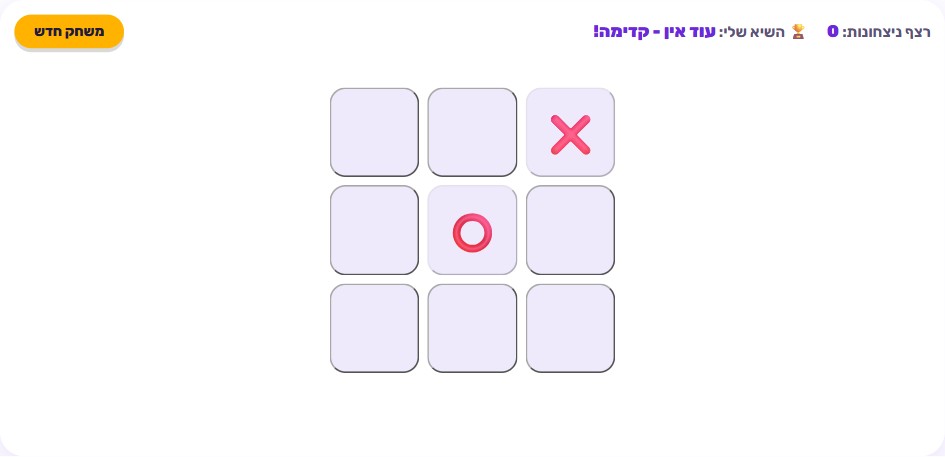
🎯 How to play
- Click any empty square on the 3x3 board to place your X there.
- The computer answers immediately with an O, following a fixed priority order: win if it can, block you, take the center, take a corner, or pick randomly.
- Keep alternating turns until someone lines up three matching marks (a row, column, or diagonal), or the board fills up in a tie.
- A win adds stars and raises your consecutive win streak by 1; a loss resets that streak back to zero.
- Five wins in a row against the computer unlock the "Tic-Tac-Toe Champion" avatar.
- Click "New Game" to start another round instantly, no page reload needed.
Where this game comes from - a genuinely ancient history
Tic-tac-toe feels like a simple modern pastime, but the underlying idea - a grid of squares where two players race to line up marks - is likely one of the oldest documented game concepts we have. Archaeologists have found grid boards carved into stone at ancient Egyptian temple sites dating back to roughly 1300 BCE, sometimes linked to grid-based games played there. In ancient Rome, people played a game called “Terni Lapilli” (three little stones), where each player got only three stones and had to slide them between nine squares to form a line - a rule that echoes today’s game closely, with one interesting twist: because each player had only three stones, you couldn’t just keep placing new marks forever, you had to move your existing ones around the board too.
The version we know today, where X’s and O’s stay fixed once placed, is documented in England as “Noughts and Crosses” as early as the 19th century, and spread worldwide from there under different local names. It’s worth being careful about exact dating - it’s hard to say with full certainty that the earliest documented grid games were identical to today’s rules - but the basic pattern of “grid plus line up three” shows up across distant, unrelated cultures over thousands of years, which makes it one of the simplest and most enduring thinking games in human history.
The mathematical fact that makes the game interesting
There’s a proven mathematical fact about tic-tac-toe worth knowing, because it changes how you think about the game: if both players play perfectly optimally - meaning each one always makes the objectively best possible move - the game always ends in a tie. This isn’t a theory, it’s a fully proven fact: the board is small enough (just nine squares) that every possible game can be mapped out completely in a fraction of a second by computer, and that mapping shows with certainty that neither side has a guaranteed winning strategy against an opponent who doesn’t make mistakes.
The practical takeaway: if you lose at tic-tac-toe, it’s always because someone (you or your opponent) made a mistake along the way - not because the game is somehow rigged against whoever goes second, and not because luck is involved. And the reverse holds too: if you play perfectly every single turn, the worst that can happen to you is a tie - you literally cannot lose. That’s why tic-tac-toe, despite its simplicity, is classified as a “solved game” in game theory - it has a complete, absolute mathematical answer, unlike a game such as chess, which still isn’t fully solved.
How the computer “thinks” - the algorithm behind your opponent
The computer opponent here doesn’t use machine learning or “AI” in the modern sense - it follows a simple, fixed priority list that it checks on every single turn, in this exact order:
- Win immediately, if possible. If the computer has a move available that completes three O’s in a row, column, or diagonal, it always takes it, without hesitation.
- Block you, if you’re about to win. If the computer has no winning move of its own, but you have a move that would complete three X’s on your next turn, it blocks that square.
- Take the center. If neither side has an immediate threat, the computer prefers the center square - it’s the strongest square on the board, since it’s part of four possible winning lines at once (a row, a column, and both diagonals).
- Take a corner. If the center is already taken, the computer prefers a corner over an edge square - corners participate in three winning lines (a row, a column, and one diagonal), while edge squares only participate in two.
- Pick randomly among whatever squares remain, if none of the rules above apply.
Here’s what that means for you as a player: the computer will never miss an immediate winning move, and it will never miss a block when you’re one move from winning. That means there’s no simple one-move trick that beats it. The only reliable path to victory is creating a position with two simultaneous threats, so the computer can’t block both of them on the same turn.
Real strategy tips for beating the computer
- Take the center first. If you move first, the center is the strongest opening move - it opens up the most possible winning lines for the rest of the game.
- If the center is taken, grab a corner. If the computer got the center before you, a corner is the next-best choice - it gives you more flexibility than an edge square would.
- Look for a fork opportunity. A fork is a position where one move of yours creates two winning threats at once - for example, two different rows that each need only one more X to complete. Since the computer can only block one square per turn, it can’t stop both threats, and you win on your next move.
- Always check for an immediate win before planning ahead. This sounds obvious, but plenty of players miss an immediate winning move because they’re busy “setting up strategy” instead of checking the board as it actually stands right now.
- Watch for the computer’s own double threats. Just like you can create a fork, the computer can end up with two threats at once too - try to block a square that sits on both winning lines simultaneously, not just one of them.
- A tie isn’t a failure. As shown above, a tie against an opponent that plays well is actually the mathematically “correct” outcome - don’t be discouraged by it, and remember it doesn’t reset your win streak.
Win streaks, stars, and the Champion badge
The game tracks a consecutive win streak against the computer - every win adds 1 to the streak, and every loss resets it back to zero. Here’s the important detail: a tie doesn’t count as a loss, so if a game ends with no winner, your streak stays exactly where it was, and you can keep building on it in the next round.
The number of stars you earn per win isn’t fixed - it grows as your streak grows, following the formula 15 + (current streak × 2). That means your first win in a streak is worth 15 stars, the second is worth 17, the third 19, and so on - the longer you keep your streak alive, the more each individual win is worth. It’s a nice way to reward consistency, not just a single lucky win.
And if you manage to reach five wins in a row against the computer without a loss in between, you’ll unlock the “Tic-Tac-Toe Champion” avatar - proof you’ve really figured out how to play against an opponent that never misses a chance. One thing to remember: a tie in the middle of your streak won’t break it, only an actual loss will.
Similar games on the site worth trying
If you enjoyed facing an opponent that thinks through a fixed set of rules, check out Connect Four - another thinking game against the computer, but instead of a 3x3 grid where you place a mark directly, you choose which column to drop your piece into on a taller board. If you like moves that require planning several steps ahead, Checkers is a classic board game against the computer with jump-and-capture rules that demands exactly the same kind of forward thinking as tic-tac-toe, just on a bigger, more complex board. And for a completely different take on “who controls the space,” Dots and Boxes is a thinking game where you close squares between dots - it also rewards planning ahead so you don’t hand your opponent an easy opportunity.
🧠 Test Yourself
Answer all three questions correctly to earn 100 stars!
Frequently Asked Questions
Can I play tic-tac-toe here with two players on the same device?
Not in this version. This game is always you against the computer - you play X, and the computer answers O using a fixed algorithm. If you were looking for a two-human-player version, this isn't it, but the upside is you can play instantly, any time, without needing a second player.
Is there a 3D version of tic-tac-toe here?
No. This is a classic flat 3x3 board, exactly like traditional pen-and-paper tic-tac-toe. There are no extra layers or 3D cubes involved.
Is this the same tic-tac-toe game Google shows when you search for it?
No, this is a separate, standalone game. Google does have its own built-in Easter-egg version that pops up right in search results, but this is a full game page in its own right, with a tracked win streak, stars, and a champion avatar that Google's version doesn't have.
How do you beat the computer at tic-tac-toe?
The computer will always take a winning move if one is available, and will always block you if you're one move from winning - so there's no simple one-move trick that catches it off guard. The real path to victory is taking the center on your first move and then setting up a "fork" - a position with two winning threats at once, so the computer can only block one of them.
Is the game free and does it require sign-up?
Yes. It's completely free, runs right in your browser, with no sign-up, no download, and no payment required.