
🃏
Checkers Game Guide: Rules and Tips
Checkers is moving diagonally, jumping to capture, and reaching the far row to become a king. Rules, tips to beat the computer, and the piece count.
▶️ Play Now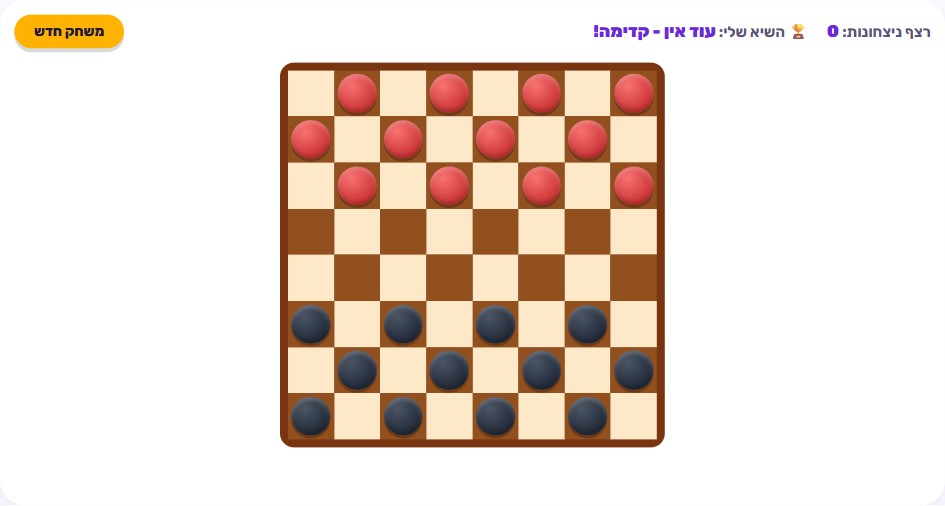
🎯 How to play
- Move a piece diagonally forward, one square, onto an empty dark square next to it.
- If an opponent piece sits diagonally next to yours with an empty square behind it, jump over it to capture it.
- If another jump opens up right after the first one, keep going in the same turn for a multi-capture.
- Get a piece all the way to the far row on the opponent's side to turn it into a king that moves diagonally in every direction.
- Win by capturing every one of the opponent's pieces, or by leaving it with no legal move left.
- String together consecutive wins to earn more points and unlock the "Checkers Champion" avatar.
Where does checkers come from?
Checkers is one of the oldest and most widely played board games in the world, and its origins are very old, generally traced back across multiple cultures that each developed their own version of a jump-and-capture game on a grid over thousands of years. Over the centuries, similar rule sets took shape in different places, until the version we know today settled into its modern form in recent centuries: an 8x8 board, two colors of pieces, and diagonal-only movement. That’s part of why checkers stayed so popular everywhere - the rules are simple enough for a kid to learn in minutes, yet deep enough that a full game can mean thirty minutes of real thinking.
Unlike chess, where every piece type moves differently, in checkers every regular piece moves exactly the same way - which is exactly what makes it so approachable for beginners. But don’t let that simplicity fool you: experienced checkers players think several moves ahead, much like in chess, and spotting a good capture trap can decide an entire game in one move.
The digital version on this site keeps that same idea intact without any physical board or pieces to lose - it’s ready instantly in your browser, against the computer, whenever you feel like playing.
Why it’s more than “just a game” - what it actually trains
Checkers trains thinking several moves ahead - the ability to picture not just your next move, but how your opponent will respond, and what happens after that. That’s the same skill used in solving a math problem or planning a complex task: thinking through the consequences before acting, instead of just reacting to the current moment.
Beyond forward planning, the game also trains risk spotting. A piece left in the wrong spot can get captured in a double jump - two pieces at once - and that’s exactly the kind of mistake players learn to avoid over time. Scanning the board and asking “where am I exposed right now” is a skill that sharpens with every game played.
There’s also a real element of patience and restraint. Sometimes the most tempting move - an easy capture - is exactly the move that leaves you open to a trap. Good players learn to pause and check the whole picture before clicking, instead of acting on the first impulse. That’s a skill that carries well beyond the board.
The rules in this version
This version is classic checkers on an 8x8 board, with 12 pieces per side at the start - exactly like traditional checkers. Every piece moves diagonally forward, one square at a time, onto an empty dark square. When an opponent’s piece sits diagonally next to yours with an empty square right behind it, you can jump over it to capture it - and if another jump opens up immediately after, you can keep going in the same turn for a multi-capture chain.
One thing worth knowing: the computer favors capture moves when one is available to it, but the rules here don’t enforce “forced captures” on the human player - even when you have a jump available, you’re not required to take it. That’s a slightly simplified ruleset compared to strict tournament rules, and it gives you a bit more strategic flexibility.
When a piece reaches the far row on the opponent’s side of the board, it becomes a king. A king keeps the same diagonal movement, but can now move both forward and backward - a real upgrade, since it’s no longer stuck once it hits the edge of the board.
The game ends in a win once you’ve captured every one of the opponent’s pieces, or once it has no legal move left. Worth being precise here: this version is checkers against the computer only, not a two-player mode on the same device - it’s built for anyone who wants a quick, always-available challenge without waiting for a human opponent. And of course, no download is needed at all - everything runs right in the browser.
For scoring, your personal best is measured by your longest win streak - every win adds base points plus a bonus that grows the longer your streak gets. Reach a streak of 5 wins in a row and you’ll unlock the special “Checkers Champion” avatar.
Real tips to beat the computer
- Control the center of the board. Pieces in the center reach more directions and more possible moves than pieces stuck on the edges. Spreading pieces toward the center early gives you more flexibility later on.
- Avoid leaving a piece open to a double jump. Before every move, check whether it leaves a piece in a spot where the computer can capture two pieces in a row. That’s the costliest mistake in the game, and it’s usually spottable in advance with a careful look.
- Aim to king a piece. Once you have a king, you have a piece that moves diagonally in every direction - a huge advantage. Sometimes it’s even worth sacrificing another piece to clear a path for a potential king.
- Force trades when you’re ahead in piece count. If you have more pieces than the computer, every trade (piece for piece) shrinks the relative gap and brings you closer to a win - the same logic strong players use in other board games too.
- Think at least two moves ahead. Instead of only checking whether the current move looks good, ask yourself what the computer will do in response, and what happens after that. That’s the difference between a beginner and a player who sees traps before they close.
- Keep your back row as full as possible early on. As long as you have pieces on your starting row, it’s harder for the computer to king its own pieces - because it has to get past you to reach it.
Similar games on the site worth trying
If you enjoyed the strategic thinking in checkers, check out Tic-Tac-Toe - a classic thinking game against the computer that has you planning one move ahead on a small, focused board. If you want a slightly deeper planning challenge, Connect Four has you weighing offense and defense at the same time on every move, much like checkers. And for a different kind of spatial thinking, Dots and Boxes trains long-range planning and board control.
🧠 Test Yourself
Answer all three questions correctly to earn 100 stars!
Frequently Asked Questions
How many pieces are on a checkers board?
In classic checkers, same as this game, each side starts with 12 pieces on an 8x8 board - 24 pieces total at the start of the game.
Can I play checkers for two players on this site?
No - this version is checkers against the computer only, not a two-player mode on the same device. That's exactly what makes it easy to play solo whenever you have a few minutes.
Do I need to download anything to play?
No download at all. It runs right in your browser, with no install and no sign-up - just click and play.
Am I forced to capture when a jump is available?
Not in this game. The computer favors capture moves when it has one, but you're not required to jump even when a capture is available - it's a simplified ruleset compared to strict tournament rules.
When does a piece become a king?
A piece becomes a king the moment it reaches the far row on the opponent's side of the board. A king moves diagonally forward and backward, which makes it far more dangerous and useful.