
🃏
How to Win Guess the Number Every Time
How to win Guess the Number: every guess gets a higher or lower clue, and halving the range each time (binary search) finds the number in the fewest guesses.
▶️ Play Now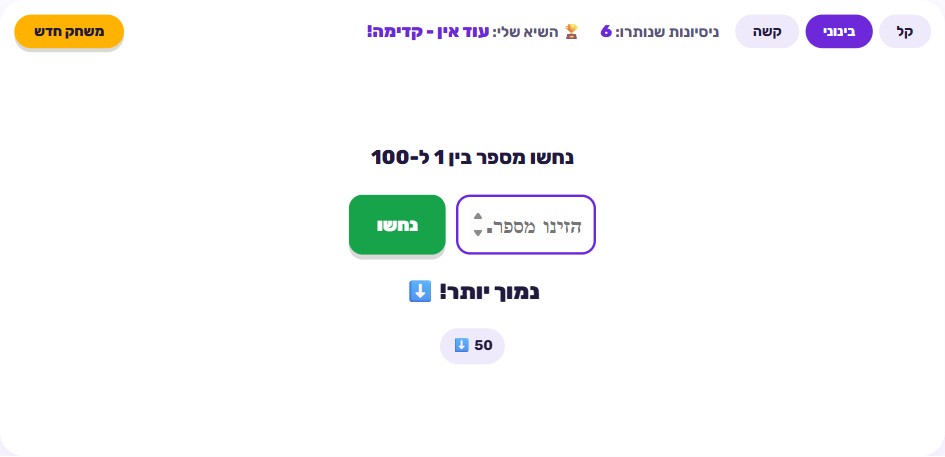
🎯 How to play
- Pick a difficulty - Easy, Medium, or Hard - which sets the range and how many attempts you get.
- Type your first guess - the smartest opening move is the exact midpoint of the range.
- Read the hint: 'higher' means the secret number is bigger than your guess, 'lower' means it's smaller.
- Use that hint to cut the remaining range in half, then guess the midpoint of what's left.
- Keep halving the range with every guess until you land on the exact number before you run out of attempts.
- The more attempts you have left when you guess correctly, the more stars you earn for that round.
What Guess the Number actually is
Guess the Number is one of the oldest logic games there is - the rules take a second to understand, but there’s real depth in it that most people never stop to notice. The computer picks a secret number inside a set range, and your job is to land on it exactly. After every guess, you get exactly one clue: “higher” if the secret number is bigger than your guess, or “lower” if it’s smaller. That’s it. No hint about distance, no “warm” or “cold” - just direction. And that’s precisely what makes the game interesting: success here isn’t about luck, it’s about method.
Our version of the game has three difficulty levels with very different ranges, so both first-time players and people who’ve already played dozens of rounds can find a level that fits. In the sections below, we’ll walk through exactly how to play this optimally - a method that mathematicians and programmers know well, and one that’s just as easy to explain to a seven-year-old as it is to a computer science student.
Binary search: the strategy that always wins
There’s one way to play this game that guarantees you’ll land on the number in the fewest possible guesses, and it takes about two minutes to learn. Its proper name is “binary search” - a real technique that computers use constantly in practice, for example when looking up a word in a digital dictionary or a name in a sorted contact list. The idea behind it is simple: on every guess, guess the exact midpoint of whatever range is left - not higher, not lower, dead center.
Why is that so smart? Because every guess at the midpoint, no matter what answer comes back, eliminates half of the remaining possibilities. Picture it this way: if there are 100 possible numbers left and you guess 50, the hint you get back - “higher” or “lower” - instantly wipes out half of them. Instead of 100 possibilities, only 50 remain. On the next guess, you again guess the midpoint of what’s left, and again cut it in half. 100 becomes 50, 50 becomes 25, 25 becomes about 12, and so on - and in under ten guesses you’ll always reach the exact number, even starting from a range of hundreds.
The beautiful part of this method is that it doesn’t depend on a lucky guess or a hunch - it works every single time, on every secret number, no exceptions. This isn’t a technique that might help; it’s mathematically provable to be the most efficient way to play this exact game. And that’s exactly what makes the game such a good tool for practicing strategic thinking: you’re not just “guessing,” you’re building a plan and executing it step by step.
A full walkthrough: cracking the 1-to-100 range
The best way to understand the method is to watch it in action. Say you’re on Medium difficulty - a 1-to-100 range with 7 attempts - and the secret number (which of course you don’t know yet) is 73.
Guess 1: The midpoint of 1-100 is about 50. Guess 50. Hint: “higher.” Now you know the number is between 51 and 100.
Guess 2: The midpoint of 51-100 is about 75. Guess 75. Hint: “lower.” The range narrows to 51-74.
Guess 3: The midpoint of 51-74 is about 62. Guess 62. Hint: “higher.” The range is now 63-74.
Guess 4: The midpoint of 63-74 is about 68. Guess 68. Hint: “higher.” The range is now 69-74.
Guess 5: The midpoint of 69-74 is about 71. Guess 71. Hint: “higher.” The range is now 72-74.
Guess 6: The midpoint of 72-74 is 73. Guess 73 - exact hit!
Notice what just happened: out of 100 possible numbers, you landed on the exact one in only 6 guesses, with one full attempt still in reserve out of the 7 allowed. That’s not a coincidence - with the midpoint strategy, even in the worst possible case on a 1-to-100 range, you’ll never need more than 7 guesses. That’s exactly why Medium difficulty is set to 7 attempts: it’s the precise number that lets the correct method win almost every time, without leaving room for aimless random guessing.
It’s also worth noticing this: in the walkthrough above, once the range narrowed down to a handful of numbers (like 72 to 74), the method kept guessing the midpoint - not guessing randomly. The principle doesn’t change just because only a few candidates remain.
Three difficulty levels - and why they’re fundamentally different
Easy: The secret number is between 1 and 50, and you get 8 attempts. This is the best starting point for anyone getting a feel for the basic idea without pressure - a small range, a generous number of attempts relative to its size, and plenty of room to make mistakes without losing the round. Each correct guess is worth 3 stars per point.
Medium: The number is between 1 and 100, with 7 attempts. This is the level where the right method really starts to matter - as the walkthrough above showed, a random guesser can easily run out of attempts without landing on the number, while someone using the midpoint strategy almost always gets there with one or two attempts to spare. Each correct guess is worth 5 stars per point - higher than Easy, because the range is tougher.
Hard: The number is between 1 and 500, with only 9 attempts. That’s a big jump - the range grows fivefold from Medium, but attempts only go up by two. Here, a random approach almost always fails, and only a precise, disciplined binary search actually lands on the number in time. Each correct guess is worth 8 stars per point, the highest of the three levels - fair, since it’s also the hardest task.
How the star scoring actually works
The scoring is built to reward two things at once: landing on the number, and how fast you got there. The formula is (attempts remaining, plus one) multiplied by that difficulty’s star rate. So on Medium (rate 5), landing on the number with 4 attempts left earns you (4+1) times 5, which is 25 stars for the round. If it took all 7 attempts and you only hit it on the last one, you’d get just (0+1) times 5, or 5 stars - a lot less. And if you run out of attempts without ever landing on it, you get zero stars for that round, no exceptions.
The practical takeaway: the strategy described above doesn’t just “help you win” - it directly multiplies your star payout, because it gets you to the right answer with plenty of attempts still in your pocket.
The Champion avatar - a challenge built on consistency
Anyone chasing a longer-term goal can aim for the “Guess Number Champion” avatar. To unlock it, you need to win 5 rounds in a row, with every one of those five solved within 3 attempts or fewer. That’s a serious challenge: it means applying the midpoint strategy almost perfectly on every single round, with no wasted guesses. One important thing to know - the streak is fragile: if any round takes more than 3 attempts, or you lose a round outright, the streak resets completely and you start counting from zero again. This isn’t a one-time lucky-shot challenge; it demands real, sustained consistency.
What this game actually teaches
Beyond the satisfaction of the “aha, got it!” moment when you land on the exact number, there’s genuine value here as a strategic-thinking exercise. Binary search isn’t just “a trick for this game” - it’s a foundational idea in computational thinking that’s taught in schools and universities, and even people who never touch programming get a useful thinking tool out of it: how to shrink a big problem into a smaller one with every step, instead of guessing wildly. It’s the same kind of thinking that helps outside the screen too - when flipping through a thick book, most people instinctively open somewhere near the middle instead of starting from page one.
Educationally, the game also builds persistence: after every hint you have to update your plan and avoid repeating the same guess, which demands real focus from the first guess to the last. And on a simpler level, it’s also great practice for understanding number relationships - “bigger than,” “smaller than” - something that helps kids who are still getting comfortable navigating the world of numbers.
Similar games on the site worth trying
If you enjoyed the kind of thinking Guess the Number demands, a few other games on the site scratch a similar itch. Math Race exercises a different kind of number thinking - instead of narrowing a range, you’re solving arithmetic problems as fast as possible against the clock. Number Grid focuses on memory and number recognition on a board, requiring the same kind of focus and systematic scanning as the midpoint strategy described here. And for a break from numbers while keeping the same smart-guessing logic, Five Letters applies a very similar principle with letters instead of numbers - every guess returns a clue, and you use it to narrow down what’s left.
🧠 Test Yourself
Answer all three questions correctly to earn 100 stars!
Frequently Asked Questions
How do you play Guess the Number?
The computer picks a secret number in a set range, and you try to guess it. After every guess you get a hint - 'higher' or 'lower' - and the goal is to land on the exact number before you run out of attempts.
What are the range and number of attempts for each difficulty?
Easy has the number between 1 and 50 with 8 attempts. Medium is between 1 and 100 with 7 attempts. Hard is between 1 and 500 with only 9 attempts - a much bigger range with very little room for error.
How exactly does the higher-or-lower hint work?
Every time you guess, the game compares your guess to the secret number. If your guess is too low, you get 'higher' - the secret number is bigger than that. If your guess is too high, you get 'lower'. The hint never tells you how far off you are, only which direction to move.
How are stars calculated at the end of a round?
If you guess correctly, your stars are calculated as (attempts remaining, plus one) multiplied by that difficulty's star rate - 3 on Easy, 5 on Medium, 8 on Hard. A fast correct guess is worth far more than a last-attempt guess. If you run out of attempts without guessing correctly, you get zero stars for that round.
How do you unlock the 'Guess Number Champion' avatar?
You need to win 5 rounds in a row, each one solved within 3 attempts or fewer. If any round takes more than 3 attempts, or you lose a round, the streak resets back to zero.