
🃏
Dots and Boxes: How to Play and Win
Dots and Boxes is the classic pencil-and-paper game online: draw lines, claim boxes, get an extra turn. Rules, board sizes, and real strategy tips.
▶️ Play Now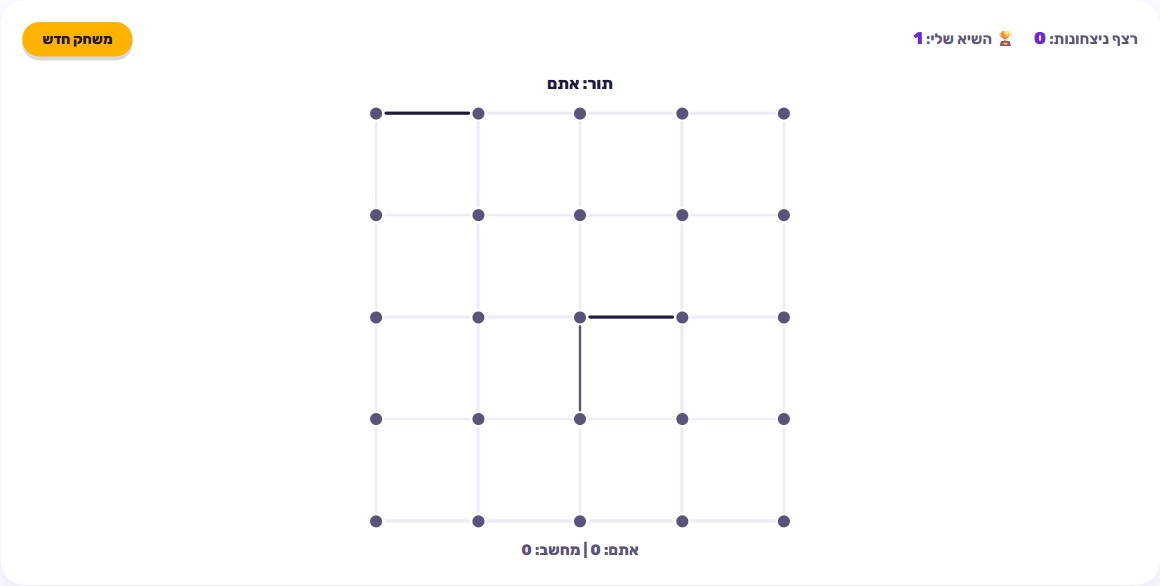
🎯 How to play
- On your turn, draw one line between two adjacent dots on the grid - horizontal or vertical.
- When a line you draw completes the fourth and final side of a box, that box is claimed and colored as yours.
- Claiming a box immediately earns you an extra turn - you get to draw another line before play passes to your opponent.
- Keep alternating lines with your opponent (the computer or a second player) until every box on the board is filled.
- Once no lines are left to draw, boxes are counted: whoever claimed more boxes wins. Ties are possible.
- Pick your board size before you start - Small, Medium, or Large - and choose whether to play vs Computer or Hotseat.
Where does Dots and Boxes come from?
Dots and Boxes is one of the oldest pencil-and-paper games there is - a game you can play on a scrap of graph paper with no special equipment at all, and yet it hides genuine strategic depth. The game is generally credited to the French mathematician Édouard Lucas in the 19th century, who described it under the name “la pipopipette” - though, like many old folk games, exact historical accounts vary a bit, and simpler forms of the idea were likely played informally even earlier. What’s certain is that the game has survived largely unchanged for well over a century, which says something about how good the core idea is: one line per turn, and claiming a box earns you another turn. There’s no dice, no cards, no luck involved at all - every outcome is a direct result of the choices both players made.
Our digital version keeps that exact same principle. The grid of dots appears on screen instead of on graph paper, you click to draw a line, and the game automatically figures out when a box closes and hands out the extra turn accordingly. That saves you from erasing a line drawn in the wrong spot, but everything else about the experience - including the need to think several moves ahead - stays exactly like the original paper game.
The rules in short
The game starts with an empty grid of dots. On each turn, a player draws one line between two adjacent dots - horizontal or vertical, never diagonal. Most turns, a line just claims its spot on the board and nothing else happens. But when a line you draw completes the fourth and final side of a box - meaning all four of its sides are now connected - that box “closes” and counts as yours. Here’s the key rule to remember: closing a box immediately earns you another turn. That’s not just a nice bonus - it’s the mechanic that makes the whole game interesting, because a chain of boxes opening up all at once can suddenly swing the entire advantage to one side.
The game continues until every possible line on the board has been drawn and every box has been claimed by someone. At that point, boxes are counted: whoever has more closed boxes wins. If both sides end with exactly the same number of boxes, that’s a legitimate tie, not a bug - and it happens fairly often on smaller boards.
The three board sizes
You can choose between three sizes before starting a game. Small is 4x4 boxes - great for a quick game that takes just a few minutes, and it’s the easiest way to learn the game for the first time since you can see the whole board at once and plan ahead. Medium is 5x5 boxes - the sweet spot: enough boxes for real strategy to start mattering, without a round dragging on too long. Large is 6x6 boxes - the most boxes to fight over, the most possible lines, and the most opportunities for long chains of boxes to swing the final result. The bigger the board, the more decisive long chains become.
Two ways to play: vs Computer or Hotseat
There are two modes. Vs Computer pits you against a computer opponent, and it’s the mode that’s actually scored: a win adds one to your win streak and earns you stars (20 base stars, plus 2 more for every box you claimed beyond your opponent’s total). A tie earns a flat 8 stars, and a loss resets your streak - no stars at all. Your personal best is tracked as your longest streak of consecutive wins, separately for each of the three board sizes.
Hotseat is the second mode - two human players take turns on the same device, passing control back and forth. It’s perfect for playing with a sibling or a friend in the same room, with no shared internet connection or second device needed. One thing worth knowing: Hotseat mode awards no stars and tracks no win streak at all - it’s pure two-player fun, not a competition against the system.
The strategy that turns a simple game into a deep one: the double-cross
At first glance, Dots and Boxes looks far too simple for real strategy - after all, all you do is draw a line. But experienced players know a well-documented technique called the “double-cross” strategy, familiar to Dots and Boxes players everywhere. The idea: when a long chain of boxes opens up, all ready to be claimed, it’s sometimes better not to take the whole chain. Instead, you deliberately leave the last two boxes in the chain open (instead of closing both of them), forcing your opponent to open up a new, bigger chain on their turn. You give up two small boxes now, in order to win a much bigger chain a few turns later.
That’s exactly why Dots and Boxes, despite its simple look, has earned serious academic attention in game theory - it’s a great example of a game with extremely simple rules and a surprisingly deep strategic space, similar in spirit to chess or Go, just on a much smaller and easier-to-learn scale.
Real tips for beginners
- Avoid drawing the third side of any box for as long as you can. Once a box already has three sides, any player can close it with a single line - meaning you just handed your opponent a free box. Early in the game, always prefer lines that don’t create a three-sided box.
- Count ahead before drawing a line. Especially on Medium and Large boards, it’s worth pausing to check: does this line open up a box with three sides? If it does, it’s likely to come back and bite you.
- Start on the Small board. A 4x4 board is the fastest way to understand the pace and consequences of each line, before jumping to the Large board with a lot more to keep track of.
- Watch for chains forming mid-game. Once a connected chain of boxes opens up, it’s worth thinking about the double-cross strategy instead of greedily taking everything - that’s exactly the difference between a beginner and an experienced player.
- Play several rounds in a row on the same board size. The patterns repeat, and the more you play at one size, the faster you’ll spot which lines are dangerous and which are safe.
Similar games on the site worth trying
If you enjoy the mix of simple rules and real strategy, you’ll also like Tic-Tac-Toe - another classic you can play against the computer or a friend, where small decisions shape the whole board. For a game that asks you to plan a few more moves ahead, Connect Four demands exactly that kind of forward thinking, much like Dots and Boxes. And if you love classic board games in general, Checkers offers the same long-term strategic feel in a digital pencil-and-paper-style classic.
🧠 Test Yourself
Answer all three questions correctly to earn 100 stars!
Frequently Asked Questions
What is Dots and Boxes?
Dots and Boxes is a game where two players take turns drawing lines between dots on a grid. Whoever draws the fourth side of a box claims it and gets an extra turn. Whoever claims the most boxes once the board is full wins.
What's the difference between the three board sizes?
There are three sizes to choose from: Small (4x4 boxes) for a quick, short game, Medium (5x5) for a balanced challenge, and Large (6x6) if you want a longer game with a lot more boxes to fight over.
What's the difference between vs Computer and Hotseat mode?
In vs Computer mode you play against a computer opponent, and every win or tie earns you stars and builds a win streak. In Hotseat mode, two human players take turns on the same device - no stars, no streak tracking, just the game itself.
How do you unlock the Dots and Boxes Champion avatar?
The Dots and Boxes Champion avatar unlocks after a streak of 5 consecutive wins in vs Computer mode. It doesn't unlock in Hotseat mode, since Hotseat doesn't track win streaks at all.
Is there a free dots and boxes game online?
Yes, this game is completely free, runs right in your browser with nothing to download, and you can play it both against the computer and against a friend on the same screen.