
🃏
Connect Four: How to Play and Win Guide
Connect Four vs the computer on a 7x6 board - drop discs into columns and connect four in a row. Rules, real strategy tips, and the solved-game trivia.
▶️ Play Now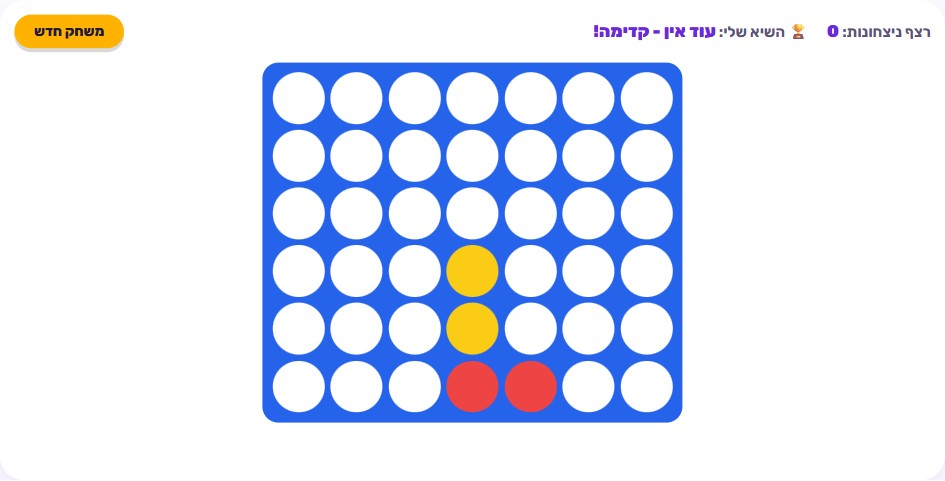
🎯 How to play
- Pick one of the seven columns on the board and click it to drop a disc.
- The disc falls straight down to the lowest empty spot in that column.
- The computer takes its turn right after, and you keep alternating.
- Try to connect four discs in a row - horizontally, vertically, or diagonally.
- Whoever connects four first wins that round.
- If the board fills up with no four-in-a-row, it's a tie.
What Connect Four actually is
Connect Four is a classic strategy game played on an upright board with 7 columns and 6 rows. On each turn, a player drops one disc into a column - the disc doesn’t land wherever you want, it falls by “gravity” to the lowest empty spot in that column, exactly like the familiar physical version. The goal is simple: be the first to connect four discs in a row, whether that’s a horizontal line, a vertical column, or a diagonal in either direction. In this site’s version, you always play against the computer rather than a second human player, so you can jump in solo any time and practice strategy without waiting for an opponent.
That simplicity is exactly what makes the game so addictive. No cards, no dice, no luck involved - just a board, two disc colors (red and yellow), and a sequence of decisions where each one reshapes everything you can do on the next turn. It takes a minute to learn and years to fully master.
The real history behind the game
Connect Four wasn’t invented yesterday. The well-known commercial version was released in 1974 by the toy company Milton Bradley, and it has sold millions of copies worldwide ever since under that exact name. But what makes the game especially interesting mathematically was proven a few years later: computer scientists showed that Connect Four is a “solved game” - meaning that with perfect play from both sides, the outcome can be known in advance. The proof shows that the first player can always force a win by starting exactly in the center column - a verified mathematical fact that shows up in game theory courses to this day. That’s not just fun trivia - it’s also the foundation of the single most important strategy tip in this guide, explained in detail below.
Being a “solved” game doesn’t make it any less fun to play. Even a player who knows the theory still has to execute every correct move in practice, against an opponent (or a computer) trying to punish every mistake. And when the opponent is a computer with predictable behavior, there’s a genuinely effective way to learn to beat it - which is exactly what this guide is for.
How the computer thinks - and why that matters
To beat the computer, it helps to understand exactly how it picks its moves. Its logic is simple and follows a strict order:
- If it has an immediate winning move, it takes it. The computer always checks first whether it can win this turn, and if so, it never passes up the chance.
- If it can’t win but you can, it blocks you. This is its basic defense: if you’re one move away from connecting four, the computer places its disc exactly where it needs to in order to stop you.
- If neither of those applies, it favors the center of the board with 70% weighting - meaning most of the time it plays the center column or close to it.
- And if none of that applies, it picks a random column.
That logic is smart enough to make the game genuinely challenging, but it doesn’t “think ahead” the way a strong human player does - it won’t spot a complex double-threat setup unless one of those threats is already an immediate win or block. That gap is exactly what you can exploit.
Real strategy tips to win more
- Claim the center column early. This isn’t superstition - the middle column is part of more possible winning lines than any other (horizontal, vertical, and diagonal all pass through it), so a disc in the center is simply worth more than one on the edge. This lines up directly with the mathematical proof above: the player who starts in the center starts with a genuine advantage.
- Build a double threat - two winning spots at once. Since the computer only blocks one threat per turn, if you can set up a position with two different spots that each complete a four-in-a-row, the computer can only block one of them. Your next move wins the game.
- Watch diagonals, not just rows and columns. New players tend to focus only on straight lines, but diagonals build up quietly over several turns and often go unnoticed - by the computer and by you - until they’re nearly complete.
- Think two moves ahead, not just one. Before you drop a disc, ask not only “is this a good move right now” but also “what does this set up for my next turn, and what does it hand the computer.”
- Don’t fill columns without a purpose. Every disc you drop permanently changes the open height in that column - a careless drop can accidentally prepare exactly the spot your opponent needed.
- Play several rounds in a row to learn the computer’s pattern. Since its logic is fixed (win, block, center, random), the more you play, the easier it becomes to predict exactly when it’s playing “on purpose” and when it’s just guessing.
Scoring, streaks, and the Champion avatar
Every win earns points using the formula 15 + (current streak x 2) - so the longer your streak runs, the more each additional win is worth. A loss or a tie earns no points at all. The streak itself resets on any loss, which means your real high score isn’t your total lifetime wins - it’s the longest unbroken streak you’ve managed to hold onto.
Reaching a streak of 5 wins in a row unlocks the special “Connect Four Champion” avatar - an achievement that requires not just winning once, but doing it again and again without slipping up. If the tips above help you win consistently, that streak is closer than it feels.
Similar games on the site worth trying
If you enjoyed the strategic thinking in Connect Four, check out Tic-Tac-Toe - another classic strategy game against the computer, simpler but built on the same block-and-win principle. For a deeper challenge with jumps and captures, Checkers demands planning several moves ahead in much the same way. And if you want a different spin on “claiming territory,” Dots and Boxes offers similar spatial thinking, with the option to play against a friend on the same device too.
🧠 Test Yourself
Answer all three questions correctly to earn 100 stars!
Frequently Asked Questions
Can I play Connect Four for two players, against a friend?
Not in this version - it's solo against the computer, not a second human player. If you want a head-to-head game on the same device, try Dots and Boxes on this site instead.
Is this a 3D version of Connect Four?
No, this is the classic flat 2D board - 7 columns by 6 rows, just like the original game. There's no 3D version here.
How does the computer decide where to play?
It first checks for an immediate winning move and takes it. If there isn't one, it checks whether you're about to win and blocks that spot. If neither applies, it favors the center column with 70% weighting, and otherwise picks a random column.
How is the high score tracked?
Your best score is your longest consecutive win streak. Any loss resets the current streak, so beating your record means winning again and again without losing in between.
Is it free to play, and do I need to sign up?
Yes, it's completely free and runs right in your browser - no sign-up and nothing to download.