
🃏
True or False: Fast Trivia Quiz Guide
True or False is a quick trivia quiz with a countdown timer on every question: three difficulty levels, speed-based scoring, and a perfect-run bonus.
▶️ Play Now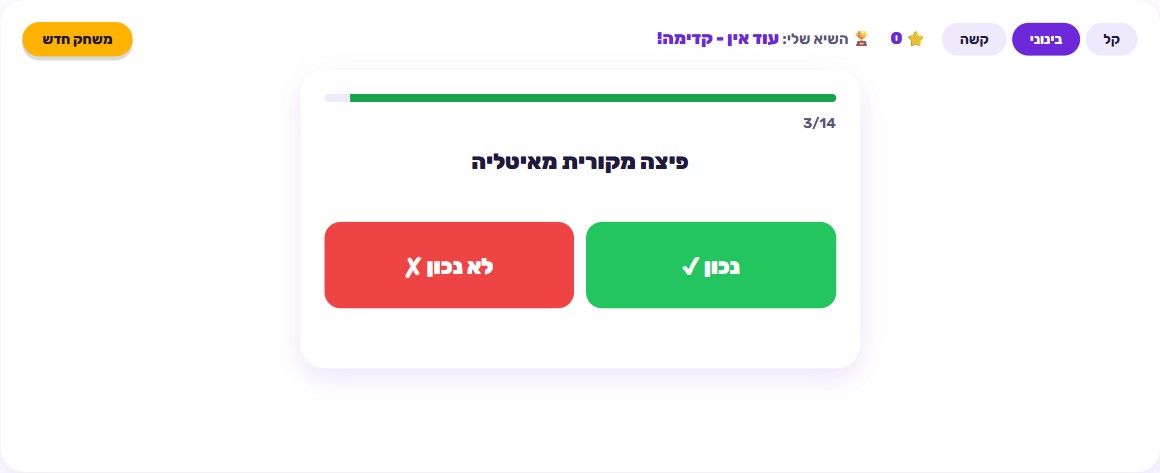
🎯 How to play
- Read the statement on the screen quickly, but all the way to the last word.
- Pick a difficulty: Easy, Medium, or Hard - each has its own number of questions and time per question.
- Tap the True button or the False button before the timer at the top hits zero.
- A correct answer scores points based on the difficulty; a question where time runs out counts as wrong.
- Move straight to the next question - there's no pause between statements.
- Clear an entire difficulty without a single mistake to earn a perfect-run bonus.
What is True or False, and why is it so addictive
The idea couldn’t be simpler: a statement appears on screen, and you decide whether it’s true or false - before the timer runs out. There’s no list of options to weigh, no hints, just the statement and the clock. That simplicity is exactly what makes it addictive: there’s no moment spent figuring out “how to answer,” only one moment of decision. The statements range across general knowledge, facts about Israel, and science, so every question is a small surprise instead of a repeat of the same topic.
What sets this version apart is that the timer resets on every single question. It isn’t one running clock for the whole game - it’s a personal countdown per statement, starting fresh each time. That means you can’t “bank” leftover time from an easy question to spend on a harder one later: every question stands on its own, with the exact same time budget as every other question at that difficulty.
Why true-or-false quizzes are so popular - in classrooms and on TV alike
True-or-false is one of the oldest and most common formats in education, for good reason: the answer is always binary, so anyone can respond instantly without composing a sentence or scanning a long list of choices. Teachers use it to check in a flash whether a class absorbed a fact, without spending time on elaborate questions. That same trait - an almost instinctive response speed - is exactly why the format is also a staple of popular TV trivia game shows, where a fast pace and time pressure are part of the entertainment itself. In the spirit of those fast-paced TV trivia formats (with no official connection to any specific show), this game is built around the same core idea: a quick answer, real pressure, and instant satisfaction when you get it right.
Beyond the fun, there’s real value here too: because the answer is always binary, your brain learns to focus on the small details of a sentence instead of guessing from a general gut feeling. A statement that starts out true and ends on one wrong detail - a wrong date, a wrong number, a single word that flips the whole meaning - trains you to read carefully instead of skimming. That’s exactly the skill the game demands in real time, and why it works equally well for learning and for pure fun.
Three difficulty levels - which one fits you
Easy gives you 10 questions with 8 seconds per question, and a correct answer is worth 5 points. It’s the natural starting point for anyone getting a feel for the game’s rhythm without extra pressure - 8 seconds is plenty of time to read a full statement calmly and still decide with confidence.
Medium raises the stakes: 14 questions, 6 seconds per question, and 7 points for a correct answer. The gap between 8 seconds and 6 seconds looks small on paper, but in practice it changes the whole approach - there’s no time left to “think twice,” you have to read and decide in almost the same instant.
Hard is the real challenge: 20 questions with just 4 seconds each, and 10 points per correct answer. At 4 seconds, there’s no room for a slow read - you need to spot the critical word in the statement (the number, the name, the word “not” that changes everything) almost immediately. This is the level where experienced players really feel the difference between reading fast and just glancing at a sentence.
Worth remembering: the score is simply the number of correct answers multiplied by that difficulty’s point value. There’s no penalty for a wrong answer beyond missing out on the points - and anyone who clears an entire difficulty without a single mistake earns a 10-point bonus on top of the regular score, for a perfect run.
Real tips for playing well under a tight timer
- Read fast, but read the whole statement. This is the most common mistake: stopping halfway through and deciding based only on the opening. One word at the end of a sentence - a number, a place name, or the word “not” - can flip a statement that sounded true into one that’s false, and vice versa.
- When you’re not sure, guess - don’t let the timer hit zero. A wrong answer and a wrong guess score exactly the same. But a guess gives you a 50% chance of being right, while a timeout is a guaranteed loss. There’s no logical reason to “wait it out” until time runs out.
- Start on Easy even if you’re confident. 8 seconds is a good pace to learn the kinds of statements the game likes to use - round numbers that look right but aren’t, facts that sound strange but are true. Once that rhythm feels familiar, moving up to Medium and even Hard feels much more natural.
- Focus on the key words, not every word equally. Numbers, names, and negation words (“not,” “never,” “always”) are where statements tend to flip between true and false. Train yourself to scan specifically for those.
- Don’t let one mistake wreck your run. Even after a wrong answer, the next question starts completely fresh - same time limit, same opportunity. There’s no accumulating penalty beyond missing the points on the question you got wrong.
- Aim for a perfect run on Hard if you want the Champion avatar. It takes 20 correct answers in a row with just 4 seconds each - a demanding target, which is exactly why earning it feels so satisfying.
What makes a true-or-false question genuinely hard
Not every question is equally tricky, even within the same difficulty. Three patterns are worth knowing: statements with a number close to the truth (a year or a quantity just slightly off from the real fact) are the most deceptive, because your brain recognizes most of the sentence as correct and skips past the one precise detail. Statements with double negatives demand a slower read, since it’s easy to confuse “it isn’t true that this didn’t happen” with the plain meaning. And statements about an unfamiliar topic (a specific science fact, say) force you to rely on an educated guess rather than certain knowledge - which is exactly where the “guess rather than miss” rule pays off the most.
Similar games on the site worth trying
If you enjoyed the fast pace of True or False, check out Flash Quiz - a general-knowledge quiz racing the clock, with the same time pressure but a multiple-choice format instead of a binary one. If you like combining trivia with Jewish learning, Mishnah Quiz offers a similar challenge built around study content. And for lighter trivia about beloved characters, Toy Story Trivia uses the same question-and-answer core in a completely different world of content.
🧠 Test Yourself
Answer all three questions correctly to earn 100 stars!
Frequently Asked Questions
How many difficulty levels does the true or false game have?
Three: Easy with 10 questions and 8 seconds per question, Medium with 14 questions and 6 seconds each, and Hard with 20 questions and just 4 seconds per question.
What topics do the true or false statements cover?
The statements mix general knowledge, facts about Israel, and science - a blend that works for school-age kids and adults who enjoy a quick trivia quiz alike.
What happens if time runs out before I answer?
A question that isn't answered in time counts as wrong, exactly like an incorrect answer. That's why it's always better to guess at the last second than let the timer hit zero.
How do I unlock the True/False Champion avatar?
Clear Hard difficulty - 20 questions at 4 seconds each - with every single answer correct. One perfect run on Hard is enough to unlock it.
Is this game connected to any TV trivia show?
The spirit is similar - a fast pace and a short time limit, like popular TV trivia game shows - but this is a fully independent game with no official tie to any specific show.