
🃏
Bowling Guide: How to Play and Score
Bowling means rolling a ball to knock down 10 pins over 10 frames. Learn how to throw, score a strike or spare, and what a perfect game means.
▶️ Play Now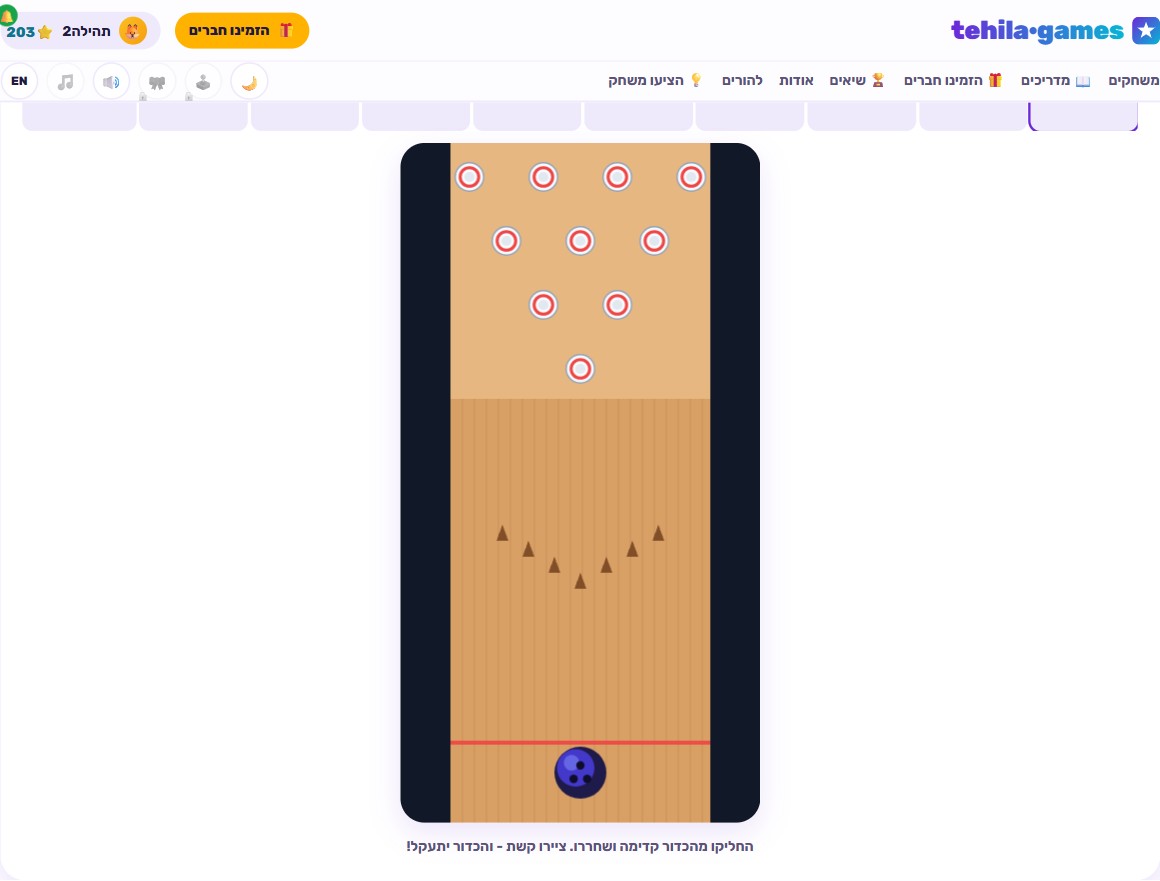
🎯 How to play
- Pick your aim - straight at the middle of the ten pins, or a slight angle toward either side.
- Set the throw's power - too strong or too weak and the ball misses pins on the edges.
- Release the ball down the lane and watch how many pins it knocks down.
- If pins are still standing, you get a second ball in that same frame to try for a spare.
- Each frame closes and you move to the next - a full game has 10 frames total.
- After all 10 frames you get a final score and stars - and every strike (all 10 pins on one ball) is worth more.
Where this game comes from - a bit of bowling history
Bowling is one of the oldest, most well-documented pin-and-ball games around. Archaeologists have found evidence of games built on the same basic idea - rolling a round object at standing targets - stretching back thousands of years, in ancient Egypt and in various cultures across the Mediterranean and Europe, though of course those early forms looked very different from what we play today: no straight lane, no fixed count of ten pins. The exact rules of those ancient games aren’t always fully known, but the underlying idea - roll a round object at a standing target - keeps reappearing across history, in cultures with no connection to one another.
Through the medieval period and into early modern Europe, and especially in Germany, different regional versions developed with varying numbers of pins and lane setups: nine pins was a very common arrangement across Europe for a long stretch of time, lane length varied by region, and even the scoring rules differed from town to town. The version we know today - ten pins arranged in a triangle, a standardized lane length, and precise per-frame scoring - came together and standardized mostly in the United States over the 19th and 20th centuries. Bowling organizations unified the various local rulebooks into one standard so leagues and tournaments could compete fairly across different lanes and cities - without a shared standard, there was no honest way to compare a score set on one lane to a score set on another. Since then, bowling has grown from local entertainment into an organized sport with leagues, world championships, and lanes all over the world - and at its core, it’s still the same simple idea that’s followed us for thousands of years: roll a ball, knock down as many pins as you can.
This game’s digital version follows those real, official bowling scoring rules exactly - ten frames, strikes, spares, and bonus throws in the final frame, just like a real lane. There’s no simplified or “approximate” version here - every scoring rule is implemented the way it actually works in real bowling, including the special cases many simpler computer games skip entirely.
How the scoring actually works - strikes, spares, and bonuses
This is the part most people never fully get, so let’s break it down slowly.
A strike happens when you knock down all 10 pins with your very first throw of the frame. It’s worth 10 base points, plus a bonus equal to the score of your next two throws (from the following frame). That means a single strike can end up worth a lot more than 10 points, depending on what happens right after it.
A spare happens when you knock down all 10 pins, but it takes both throws in the frame to do it (say, 7 pins on the first ball and the remaining 3 on the second). A spare also earns 10 base points plus a bonus - but its bonus only counts the very next throw, not two.
That’s exactly why a strike is worth more than a spare in the long run, even though both “clear the frame”: a strike’s bonus is measured across two future throws, so if you keep bowling well, every strike compounds further.
And that’s also why a perfect game (a score of 300) is so rare and hard to pull off: reaching 300 requires a strike on all 12 throws in the game - the 10 regular frames, plus two bonus throws that unlock in the 10th frame if you open it with a strike. That means 12 strikes in a row, with zero mistakes anywhere along the way. Even professional bowlers don’t do this every day - when it happens, it’s treated as a genuinely rare moment. Score 300 in this game and you’ll get a special “perfect” celebration on screen.
A worked example - building a score frame by frame
The easiest way to really understand the math is to walk through actual numbers. Say your first three frames look like this:
- Frame 1: a strike. You get 10 base points right away. Its bonus can’t be added yet - it depends on what happens in frame 2, since the bonus is the score of your next two throws.
- Frame 2: 7 pins on the first ball, 3 on the second - a spare. You get 10 base points for the spare itself, and now frame 1’s bonus can finally close out: the two throws right after it were 7 and 3, worth 10 bonus points. Frame 1 finishes at 20 points total (10 base + 10 bonus).
- Frame 3: 4 pins on the first ball, 3 on the second - an “open” frame (neither a strike nor a spare). You get exactly 7 points here, with no bonus attached. But now frame 2’s spare bonus can also close out: the next throw was 4, so that’s a 4-point bonus. Frame 2 finishes at 14 points total (10 base + 4 bonus).
After three frames like these, the running total is 20 + 14 + 7 = 41 points. Notice how every frame only “closes” for good once you see the throws that come after it - that’s exactly why strikes and spares always reach forward into the score of the next frame.
Why the 10th frame is special - and allows a third throw
In the first nine frames, you always get a maximum of two throws. The 10th and final frame is deliberately different: if you strike on your first throw, or complete a spare across your two throws, you get one extra bonus throw in that same frame - specifically so there’s something to calculate the promised bonus from. Without this rule, a strike or spare on the very last frame would be left “hanging,” with no future throw to pull a bonus from. This is exactly why a perfect game requires 12 throws instead of 10: opening the 10th frame with a strike unlocks two additional bonus throws, and both of those also have to be strikes to hold onto the full 300 points.
How stars are earned
At the end of the game, the number of stars you earn depends on your final score - the higher you score, the more stars you get. You don’t need a perfect game to feel like you’ve achieved something: every improvement in your score is rewarded right away.
Real tips for playing better
These tips aren’t hidden tricks or exploits - they follow directly from bowling’s real rules, so they work equally well on a real lane and in this digital version:
- Aim at the same spot every time, not randomly. A precise throw that repeats the same aim beats a powerful throw that swings left one time and right the next. Consistency is the real key to a high score, exactly like in real bowling - professional bowlers repeat nearly the same motion on every single throw.
- Remember that a strike is worth more than 10 points in practice. Thanks to the bonus from your next two throws, a single strike can end up dragging along far more score than it looks like at first glance - it’s worth aiming carefully for one instead of just trying to “knock down as many as possible” on every throw in isolation.
- Never skip your second throw in a frame. Even if the first ball wasn’t great, completing a spare still earns 10 points plus a bonus - that’s a meaningful difference in your final score compared to leaving the frame unfinished. An open frame (no strike, no spare) is the single biggest score loss you can have, worse than any other kind of mistake.
- Practice the same throw power a few times in a row. Once you find a combination of aim and power that knocks down a lot of pins, repeat it instead of trying something new every single frame. Constantly changing your approach makes it hard to tell what’s actually working.
- Think of all 10 frames as one whole, not frame by frame. A great final score isn’t built from one perfect frame - it comes from a run of consistently solid frames. Steady play beats one brilliant throw followed by two weak frames. Because of the bonus system, a weak frame right after a strike also eats into the score of the frame before it.
- Pay special attention to the 10th frame. Thanks to the bonus-throw rule, the last frame is your biggest single chance to add score in one go - a strike on its first ball unlocks two more throws in that very same frame, with no need to wait for a “next” frame.
- Don’t give up after one weak frame. Unlike games where a single mistake ends your whole run, in bowling every frame counts toward the running total on its own - a weak frame in the middle of a game doesn’t erase what you already scored earlier.
Similar games on the site worth trying
If you liked the mix of aim and power control in bowling, try Pool too - another game where the ball’s direction and strength decide everything. If you’re after a classic strategy game against the computer or a friend, Checkers trains planning several moves ahead. And for a quick, light round between bowling games with a friend, Tic-Tac-Toe is a fast, classic pick.
🧠 Test Yourself
Answer all three questions correctly to earn 100 stars!
Frequently Asked Questions
How do you throw the ball in this bowling game?
Choose an aim and a power level, then release the ball down the lane toward the ten pins. If any pins are left standing, you get a second throw in that same frame before moving on.
How do you play bowling in general?
A full bowling game is made of 10 frames. Each frame gives you up to two throws to knock down all 10 pins, and your score adds up across every frame into one final total.
How do you get a strike in bowling?
A strike is knocking down all 10 pins with your very first ball of the frame, with no second throw needed. It's worth 10 points plus a bonus - the score of your next two throws.
What's the difference between a strike and a spare?
A strike knocks down all 10 pins on one throw. A spare knocks down all 10 pins too, but it takes both throws in the frame. Both earn a bonus, but a strike is worth more because its bonus counts two future throws instead of just one.
What is a perfect game in bowling and what's the highest possible score?
The highest possible score in bowling is 300 points - known as a 'perfect game' - and it only happens with a strike on all 12 possible throws, including the bonus throws unlocked in the 10th frame. Pull it off in this game and you get a special on-screen celebration.