
🃏
Build a Sukkah: Game Guide
Build a Sukkah is a Sukkot learning game - 10 levels on the laws of the sukkah, a reason for every wrong answer and a sourced fact after each level.
▶️ Play Now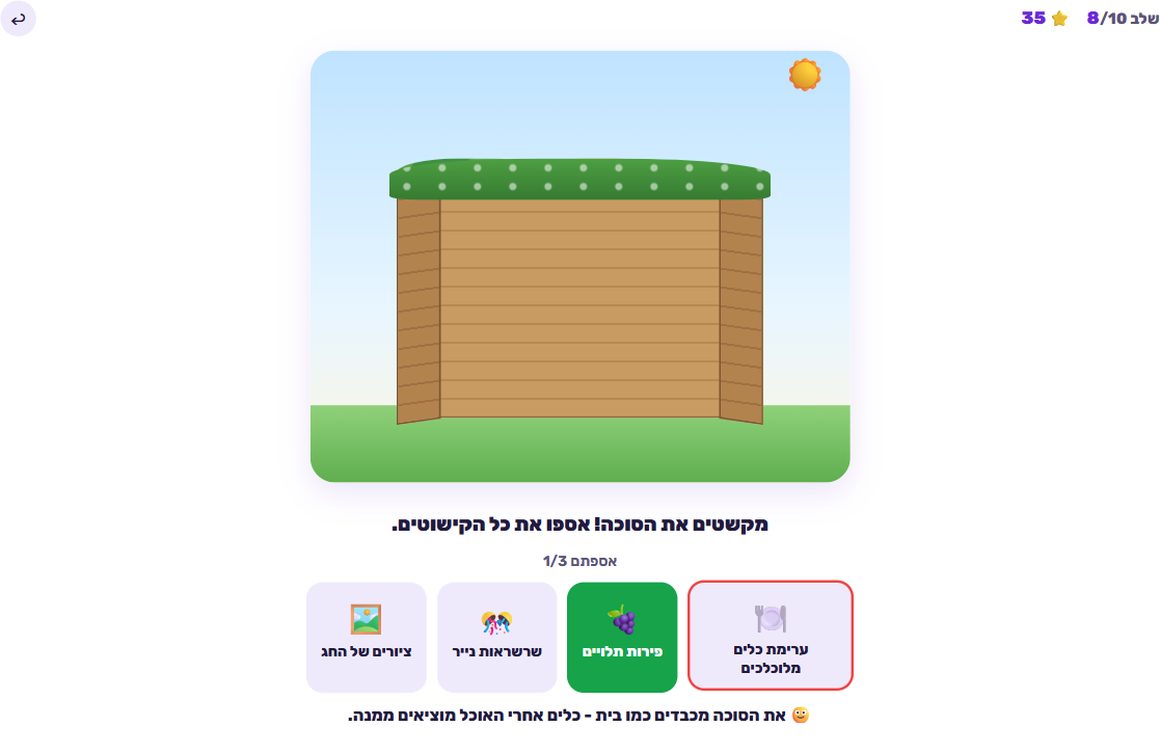
🎯 How to play
- Pick a mode - Relax with no timer and no hearts, or Challenge with a timer and 3 hearts.
- Each level asks one question about the sukkah: where to build it, how many walls, what the walls are made of, how tall, what counts as sechach, how much sechach, decorations, what we do in the sukkah, and the blessing.
- Tap the right answer. When several answers are right, collect them all - a counter shows how many are left.
- Picked a wrong answer? A short reason explains why it doesn't work.
- Each solved level adds a part to the sukkah on screen and reveals a fact with its source.
- Finish all ten levels to complete the sukkah and see your final score.
Why a game about building a sukkah
Almost every child knows we sit in a sukkah on Sukkot. Fewer know why one sukkah is kosher and another isn’t. Why not build it under a tree? Why can’t a blanket be the roof? Why branches?
These questions come up in every home while the sukkah goes up. The game brings them to the screen in the way children like to learn: build something step by step and watch it grow.
The game teaches the basics and is not a halachic source. For practical questions about the sukkah you build at home, ask a rabbi.
How the game works
There are ten levels, each with one question:
- Where to build the sukkah
- How many walls it needs
- What the walls can be made of
- How tall it is
- What goes on top as sechach
- A tricky sechach question
- How much sechach to use
- Decorations
- What we do in the sukkah
- The blessing said in the sukkah
Some levels have one right answer and some have several. For “how many walls”, both three and four are right. When there are several, you collect them all, and a small counter shows your progress.
Each solved level adds to the illustrated sukkah: first the grass, then the walls, the beams, the sechach, the decorations and the table. At the end the sukkah is ready for the festival.
Mistakes are part of the lesson
What sets this game apart is the reason shown after a wrong answer. In the laws of the sukkah, much of the learning is understanding why something is not kosher, so every wrong answer has its own explanation:
- A sukkah under a tree: branches above the sukkah make it invalid - nothing may be above the sechach.
- A blanket as sechach: cloth can become tamei, so it can’t be sechach.
- Apples as sechach: food can become tamei too. Hanging fruit as decoration is fine, though.
- A branch still on the tree: sechach must be cut off from the ground.
- An old wooden chair: a chair is a utensil, and utensils are never kosher sechach, even when broken.
A child who gets it wrong still walks away knowing something new, and remembers why next time.
The rule of sechach
Three levels focus on sechach, because it is the heart of the sukkah. The Mishnah gives a simple rule: sechach is something that grew from the ground, is no longer attached to it, and cannot become tamei.
Cut branches, palm fronds, bamboo and straw meet all three conditions. Plastic and metal never grew from the ground. A branch on the tree is still attached. Cloth, utensils and food can become tamei.
Once a child knows the rule, they can work out cases the game never showed. That is the goal.
Relax mode and Challenge mode
Relax mode is for a first look. There is no timer and no hearts, and a wrong answer only shows the reason. Each solved level is worth 5 stars, plus a 10-star bonus at the end.
Challenge mode is for players who already know the material. You get 3 hearts and a timer per level:
- Each level gives 8 seconds, plus 4 seconds for every right answer you need to collect on it.
- A wrong answer, or running out of time, costs a heart.
- When time runs out, the game highlights the right answers you still need, as a hint.
- Each solved level is worth 10 stars, and each heart left at the end is worth 10 more.
The best order: one Relax round first, then a Challenge round to see what stuck.
Using the game before the festival
A good time to play is the days before Sukkot, before building the sukkah at home. Play together, then check the real sukkah: is there a tree above us? More shade than sun? What is our sechach made of?
In a classroom, put the game on the board, let the children vote on each question, and read the reason together. The tricky level, where only the straw is kosher, usually starts a good discussion.
More games for the Tishrei holidays
Once the sukkah is built, invite the guests in Ushpizin Memory, a memory game about the seven Ushpizin with a fact about each one. If you liked the level format, Build the Temple works the same way. For the words of all the holidays, try the Tishrei word search.
🧠 Test Yourself
Answer all three questions correctly to earn 100 stars!
Frequently Asked Questions
What does Build a Sukkah teach?
The basics of the laws of the sukkah: build it under the open sky and not under a tree, how many walls it needs, how tall it may be, what counts as sechach, that it needs more shade than sun, what we do in it and which blessing we say.
What happens when I pick a wrong answer?
In Relax mode you see why that answer doesn't work, with no penalty. In Challenge mode you see the same reason and also lose one of your three hearts.
What sources is the game based on?
The Mishnah in tractate Sukkah and the Shulchan Aruch, Orach Chaim, laws of the sukkah. Each fact shows its source. The game teaches the basics - for practical questions about a real sukkah, ask a rabbi.
What age is the game for?
All ages. Relax mode suits young children and a first look, and Challenge mode with the timer suits anyone who already knows the rules and wants to test themselves.