
🃏
Brick Breaker Tips: Paddle Control and Power-ups
Brick Breaker paddle control tips: use the paddle edges to aim, catch the right power-ups and dodge the bomb. Plus color scoring, 15 levels, 3 difficulties.
▶️ Play Now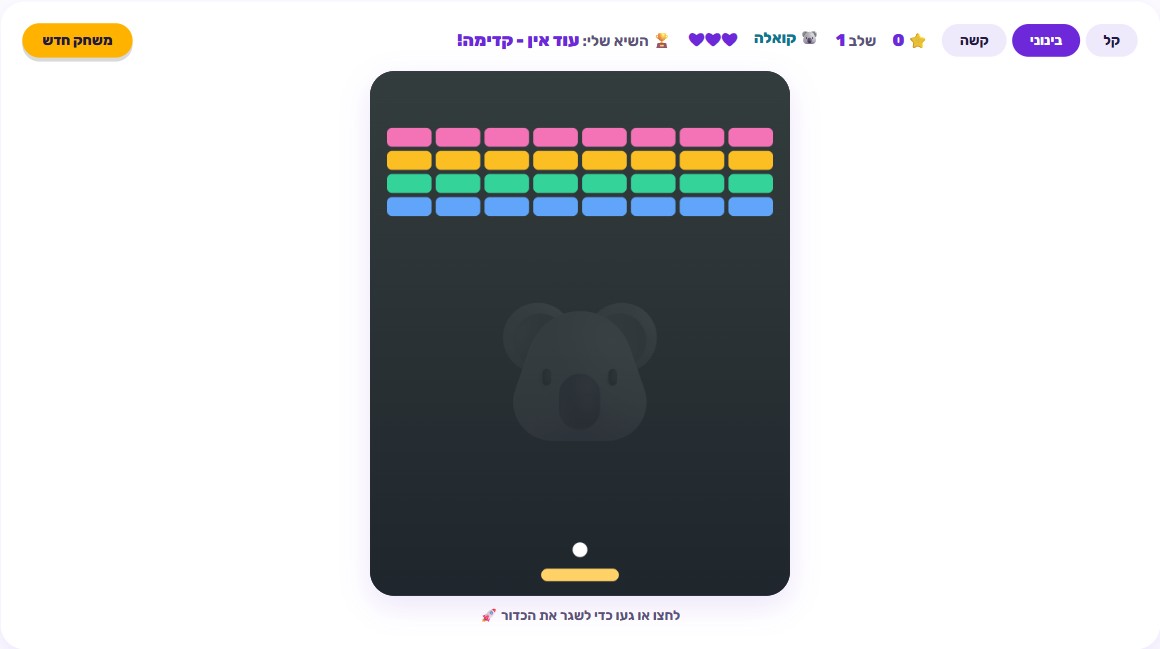
🎯 How to play
- Move the paddle left and right to catch and bounce the ball.
- Aim the ball at the colorful bricks above to smash them.
- Catch power-ups that drop from broken bricks: a wider paddle, a sticky paddle, a slower ball, or an extra life.
- Avoid the bomb power-up 💣 - catching it costs a life, just like missing the ball.
- Pick a difficulty - Easy, Medium, or Hard - before you start, to match the challenge to your skill.
- Clear all 15 levels to win the game and earn a 25-point bonus.
Where this game comes from - a short history of Breakout
Brick Breaker isn’t a new idea - it’s one of the most influential games in video game history, with a well-documented and genuinely famous origin story. The original game, simply called Breakout, was released in 1976 by Atari. The person who worked on an early hardware version of it was none other than Steve Wozniak - yes, the same Wozniak who a few years later co-founded Apple with Steve Jobs. Wozniak designed the original circuit for the game while he was still working at Atari, before he started his own company. It’s one of the most well-known and documented stories in the entire games industry - proof that a simple idea (a ball, a paddle, a wall of bricks) can spawn an entire genre.
Ten years later, in 1986, the Japanese company Taito pushed that basic idea further with Arkanoid - a massive arcade hit that added falling power-ups, boss fights, and varied brick layouts to the formula. That “recipe” from Arkanoid - a paddle, a ball, bricks, and power-ups that make every run feel different - is exactly the structure most modern brick-breaking games, including this one, are still built on. So when you play here, you’re following a direct line that starts with Atari’s 1976 original and runs straight through Arkanoid in 1986.
Why the bounce-and-break mechanic is still so satisfying
There’s a good reason this mechanic has survived almost fifty years without feeling dated: the control scheme is about as simple as it gets - one axis, left or right - but the ball itself behaves in ways that are genuinely hard to predict exactly. The angle at which the ball hits the paddle decides where it goes next, which means every small movement you make actually matters. That combination - dead-simple control on one side, genuine precision demands on the other - is exactly what creates the tension and depth that keeps players coming back for “just one more try.” It isn’t pure luck, and it isn’t pure skill either - it’s a blend of both, and that’s precisely why games built on this idea still feel fun decades later.
Three difficulty levels - how to pick the right one
The game offers three levels, and the difference between them isn’t just “easier or harder” - it’s a real change in the rules:
- Easy: 5 lives, a wide paddle, a slow ball, and a normal score multiplier (x1). This is the right starting point if you want to get a feel for the layouts and the paddle without pressure.
- Medium (the default): 3 lives, medium paddle and speed, and a x2 score multiplier. This is the sweet spot for most players - still approachable, but it demands real attention.
- Hard: 3 lives, a narrower paddle, a faster ball, but a x3 score multiplier. This is for players who already have a feel for the game and want both a genuine challenge and a much higher score - and it’s also the only way to unlock the “Breakout Champion” avatar.
One thing worth noting: there’s no clock chasing you. You only lose a life when the ball falls past your paddle - missing a brick costs nothing. That means you can play at your own pace; the only thing that matters is not letting the ball slip past you.
Color-based scoring - which bricks are worth the most
Not all bricks are equal, and that’s part of the strategy. Pink bricks are worth the most among the regular ones, at 5 points. Yellow and violet bricks are worth 4, green bricks are worth 3, and blue bricks are worth just 2. Above all of them sit the tough gray stone bricks, worth 9 points but requiring 3 hits to fully break (some bricks need just 2 hits and look visually different so you know they won’t break in one shot). What you actually earn per brick is its base value multiplied by your chosen difficulty’s score multiplier - so a pink brick on Hard is worth 15 points, and a stone brick on Hard is worth 27 points across the whole sequence until it breaks.
15 levels and five brick layouts
The game has 15 levels total, but they aren’t 15 completely different designs - there are 5 distinct brick layouts: a classic wall, steps, a star, a shofar shape, and a fortress. These layouts repeat across 3 cycles, and each cycle is faster than the one before it - so the second time you meet the “star” layout, the ball is already moving quicker than it did the first time. Five layouts times three cycles gives exactly 15 levels. On top of that, the visual theme and background also change every 5 levels, so there’s a clear sense of progress beyond just the rising speed. Clearing all 15 levels is a full win, and it also earns a 25-point bonus.
Power-ups: the helpful ones and the harmful one
When a brick breaks, there’s roughly a 13% chance a power-up drops from it - and that adds a real layer of strategy to every level. There are four helpful power-ups, each lasting 9 seconds with a blinking warning near the end so you know time is running out:
- 🎁 Wider paddle - makes catching and aiming the ball noticeably easier.
- 🧊 Sticky paddle - the ball sticks to the paddle instead of bouncing off immediately, and you relaunch it whenever you’re ready - great for precise aiming.
- 🐌 Slower ball - more reaction time, fewer mistakes.
- ❤️ Extra life - an instant life, no conditions attached.
But there’s also one harmful power-up: 💣 a bomb. It looks just like another falling power-up, but catching it costs you a life exactly the same way letting the ball fall past your paddle does. Bombs only start appearing from level 3 onward, so in the earliest levels you can safely grab anything that falls - but from level 3 on, every falling item deserves a second look before you dive for it.
Real strategy tips to beat your best score
- Go for the high-value bricks when it’s safe. Pink and stone bricks are worth the most points - when you have a clean shot at one without risking the paddle’s position, take it.
- Use the edges of the paddle to steer the ball. Hitting the ball near the edge of the paddle (rather than dead center) sends it off at a sharper angle - that’s how you reach bricks tucked into hard-to-hit corners.
- Be extra careful with the bomb from level 3 onward. When several power-ups fall at once, take a moment to tell the icons apart before rushing to catch everything.
- Grab the sticky paddle when you can. It gives you full control over your next launch angle - especially useful when only a few stubborn bricks remain.
- Start on Medium if you’ve played brick-breaker games before. It gives a genuine challenge without demanding perfect control from the very first level.
- Don’t chase every last brick at the cost of dropping the ball. There’s no penalty for missing a brick - the only penalty is for letting the ball fall, so caution beats greed here.
What it takes to unlock the “Breakout Champion” avatar
There’s a dedicated avatar for players who truly master the game: “Breakout Champion.” To unlock it, you need to clear all 15 levels on Hard difficulty - not Easy or Medium. That means surviving with only 3 lives, a narrow paddle, and a fast ball, through five different layouts and three cycles that each get faster than the last, including bombs that start showing up from level 3. It’s a real test - which is exactly why it feels like a genuine achievement when you pull it off.
Similar games on the site worth trying
If you enjoyed the speed and reflexes of Brick Breaker, try Tetris - a classic block-stacking game that demands quick thinking under similar time pressure. If you like the physics of a bouncing ball, Pong is the true ancestor of the whole paddle-and-ball genre. And for a different kind of strategic challenge, 2048 is an equally addictive numbers game - a completely different mechanic, but the same “just one more try” feeling that makes Brick Breaker so hard to put down.
🧠 Test Yourself
Answer all three questions correctly to earn 100 stars!
Frequently Asked Questions
What's the difference between the three difficulty levels?
Easy gives you 5 lives, a wide paddle, a slow ball, and a normal score multiplier (x1). Medium (the default) gives 3 lives, medium paddle and speed, and a x2 multiplier. Hard gives 3 lives, a narrow paddle, and a fast ball, but scores are tripled (x3) - bigger risk, bigger reward.
How does the color-based brick scoring work?
Each brick color has a fixed point value: pink is worth 5, yellow/violet 4, green 3, and blue just 2. Tough gray stone bricks are worth 9 points but take 3 hits to break (some bricks take 2 hits and look different so you can tell). Whatever a brick is worth gets multiplied by your difficulty's score multiplier.
What do the power-ups do, including the harmful one?
Power-ups fall from about 13% of broken bricks and last 9 seconds each, with a blinking warning near the end: 🎁 a wider paddle, 🧊 a sticky paddle that catches the ball until you relaunch it, 🐌 a slower ball, and ❤️ an instant extra life. There's also a harmful power-up, 💣 a bomb - catching it costs a life just like missing the ball with your paddle. Bombs only start appearing from level 3 onward.
How are the 15 levels structured?
There are 5 distinct brick layouts - a wall, steps, a star, a shofar shape, and a fortress - that repeat across 3 cycles, with each cycle faster than the last. Five layouts times three cycles equals 15 levels total. The visual theme and background also change every 5 levels.
What does it take to unlock the 'Breakout Champion' avatar?
You need to clear all 15 levels on Hard difficulty specifically - that's the only way to unlock it. It's a real test: just 3 lives, a narrow paddle, and a fast ball the whole way through.