
🃏
Five Letters Guide: How to Play and Win
Five Letters is a Wordle-style word game: guess a 5-letter word in 6 tries, and colored tiles guide you closer. Rules, real strategy, and tips inside.
▶️ Play Now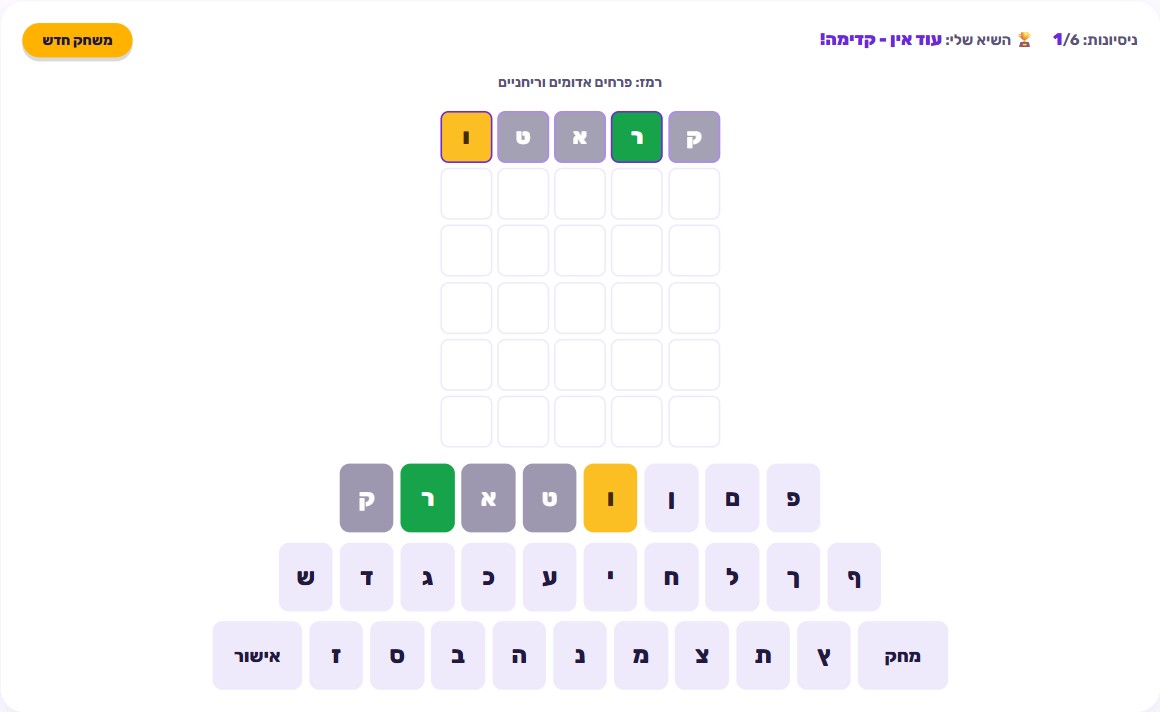
🎯 How to play
- Guess any five-letter word and submit it.
- Check the color each letter turns: green, yellow, or gray.
- Green means the letter is correct and in the exact right spot - keep it there next guess.
- Yellow means the letter is in the word, just in the wrong spot - try it somewhere else.
- Gray means the letter isn't in the word at all - you can rule it out for later guesses.
- You get up to six tries before the word is revealed - the faster you solve it, the more points you earn.
Where this style of game comes from
Five Letters is a Hebrew word game built in the style of Wordle - one of the simplest, most addictive games to come out of the internet in the last decade. The real story behind this genre is worth knowing. Wordle was created in 2021 by software engineer Josh Wardle, who originally built it as a small side project for his partner, with no commercial plans behind it at all. The idea was simple almost to the point of genius: a secret five-letter word, six tries to guess it, and colored feedback after every attempt. Within months the game went from a few hundred players to millions of players worldwide, largely thanks to a habit that made it go viral: people could copy and share their result as a grid of colored squares, without revealing the actual word - everyone’s feed filled up with friends’ green and yellow squares, and curiosity did the rest. In early 2022, Wordle was acquired by the New York Times, and it continues to be published there daily, a new puzzle every midnight.
To be clear: our game is not Wordle, and it has no official connection to the New York Times or to Josh Wardle - we’re not claiming that it does. What is fair and accurate to say - the same way you’d describe a platformer as “Mario-style” or a battle royale game as “Fortnite-style” - is that Five Letters belongs to exactly that genre: guess a five-letter word, six tries, colored feedback that builds up row by row. It’s a whole game genre that has grown since 2021, with dozens of versions in different languages around the world - Five Letters is our Hebrew take on that idea, built from scratch specifically for kids and Hebrew-speaking families.
Why word-guessing games are genuinely good brain training
Beyond the fun of solving a puzzle, games like this carry real educational value - not just a marketing line. The main reason is letter-pattern recognition: every time you see which letters belong in the word and which don’t, your brain is building a live map of plausible letter combinations. That’s exactly the skill underlying fluent reading and correct spelling - quickly recognizing which letter sequences “look like a real word” and which don’t.
The second reason is process of elimination - a logical thinking tool that reaches far beyond word games. In every new row, you’re not blindly guessing; you’re using the information you’ve already gathered to narrow down the space of possibilities. That’s the same kind of thinking needed to solve a math problem, investigate a mystery, or even debug code: asking “what do I already know, and what does that rule out?” before moving forward. Kids who practice this style of thinking in a light, casual game - without feeling like they’re “studying” - often carry it over more easily into other contexts too.
On top of that, there’s a simple, direct vocabulary and spelling workout here: guessing five-letter words means repeatedly scanning your memory for real Hebrew words, which reinforces your familiarity with them. It’s no substitute for structured reading instruction, but it’s an enjoyable practice that complements it nicely.
How our version actually works
The rules of Five Letters are simple, but worth knowing in detail so you can play smart. Each round the game picks a secret five-letter word, and you try to guess it. You get up to six attempts - no fewer, no more. After every guess, each of the five letters you typed gets colored:
- Green - the letter is correct, and it’s in the exact right position in the word. No need to touch it again.
- Yellow (or amber) - the letter is in the secret word, but not in this position. Try it somewhere else on your next guess.
- Gray - this letter doesn’t appear in the secret word at all. You can cross it off and stop wasting guesses on it.
A nice touch in our version is that this coloring doesn’t stay confined to the row itself - it also updates on the on-screen keyboard. So if you guessed the letter “R” and it came back gray, the keyboard will show it gray from that point on too, so you’ll remember without any extra effort that you’ve already tried it and there’s no point trying again. It’s a small helper, but a very effective one, especially as the round progresses and more and more letters get “checked off.”
Unlike other games on the site, Five Letters has no difficulty selector - everyone plays under exactly the same conditions, six attempts for all. Instead, each round shows a hint - the category or topic the secret word belongs to (for example, something from nature, the kitchen, or everyday life). The hint doesn’t reveal the word itself, but it’s a solid starting direction that narrows the guessing space without making the game too easy.
There’s also a scoring system worth knowing about: the fewer attempts it takes you to solve the word, the more points and stars you earn. Winning on your first or second guess is worth considerably more than winning only on your fifth or sixth try - but even a win that comes right at the wire still guarantees you a minimum score, so every win counts for something. The practical takeaway: there’s a real incentive not just to win, but to win fast and smart.
And finally - there’s a dedicated achievement for this game: an avatar called “Word Guess Champion.” It unlocks after five cumulative wins in the game. It’s worth understanding the word “cumulative” here - this isn’t five wins in an unbroken streak, but a running total that’s saved for you over time. You can win once today, skip several rounds next week, and win again a month later - every win still counts toward the goal, and once the counter reaches five, the avatar unlocks for good.
Real strategy tips worth knowing
The following tips aren’t something we invented - they’re well-known strategies that have earned a solid reputation among experienced players of word-guessing games in this style, across the world and across every language these games exist in:
- Start with a word that has common, varied letters, and ideally one or two vowels. A good opening word is one that packs in as many different, common letters as possible, rather than rare ones. The point of that first guess isn’t to accidentally “nail” the answer - it’s to gather as much information as possible about which letters even belong to the secret word.
- Treat your early guesses as information-gathering, not an attempt to solve it immediately. This is probably the single most important tip on this list. Beginners often try to “guess exactly right” as early as their first or second attempt, missing the chance to test new letters. Experienced players use their first guess or two to discover which letters exist in the word at all, and only then, from the third guess onward, start building the actual word with precision.
- Watch the keyboard’s colors, not just the rows. It’s easy to ignore the keyboard and focus only on the most recent row, but the keyboard is really a visual summary of everything you’ve discovered so far. A good habit is glancing at the keyboard before every new guess, to make sure you’re not retyping a letter you already know is gray.
- Read the hint, and let it narrow things down - not confuse you. The hint offers a topical direction, so instead of guessing completely random words, it’s worth pausing to think: which five-letter words are related to this topic? That noticeably shortens your search.
- Don’t give up after several failed rows in a row. Even skilled players sometimes reach their fifth or sixth attempt without solving it. That’s a normal part of the game, not a sign you did something wrong - sometimes the word is simply harder, and sometimes several possible words share the exact same color feedback.
- Play plenty of rounds back-to-back to rack up wins toward the champion avatar. Since the achievement is tracked as a cumulative counter rather than a streak, every winning round - even one that only comes together on your sixth guess - moves you just as far toward “Word Guess Champion.”
Similar games on the site worth trying
If you enjoyed the wordplay challenge of Five Letters, there are a few more games on the site that exercise a similar kind of thinking. Hangman is another classic word-guessing game, but from a slightly different angle - instead of colors across a whole row, you guess one letter at a time and watch how many mistakes you have left. Word Scramble flips the direction entirely - instead of guessing a brand-new word, you get the letters of an existing word in jumbled order and try to piece it back together, great practice for that same letter-pattern-recognition skill. And if you’d rather have a fast general-knowledge challenge instead of a wordplay one, Flash Quiz offers a round of varied questions racing against the clock.
🧠 Test Yourself
Answer all three questions correctly to earn 100 stars!
Frequently Asked Questions
Is Five Letters the same as the famous Wordle game?
It's in the same style, and that's intentional - Five Letters follows the Wordle format: a 5-letter word, 6 tries, and colored feedback on every guess. It's not an official Wordle release and has no affiliation with the New York Times - it's our own game, in Hebrew, built in that same beloved genre.
How many attempts do I get to guess the word?
Six attempts total. If you haven't guessed correctly by your sixth try, the word is revealed and the round ends.
What exactly do the tile colors mean?
Green means the letter is correct and in the exact right position. Yellow/amber means the letter is in the word, but in a different spot. Gray means the letter isn't in the word at all. The same colors also update on the on-screen keyboard, so you always know which letters you've already tried.
Are there hints in the game?
Yes - each round shows a hint about the word's topic or category, to narrow down your guessing direction. There's no difficulty selector in this game - everyone plays under the same conditions.
How do I unlock the 'Word Guess Champion' avatar?
The avatar unlocks after five cumulative wins in the game - a running total that persists over time, not five wins in a row. You can win today, skip a few rounds, and win again next week - every win still counts toward it.