
🃏
Build the Temple: Game Guide
Build the Temple: pick the right material for all 9 Temple parts and learn a real, sourced fact for every correct answer.
▶️ Play Now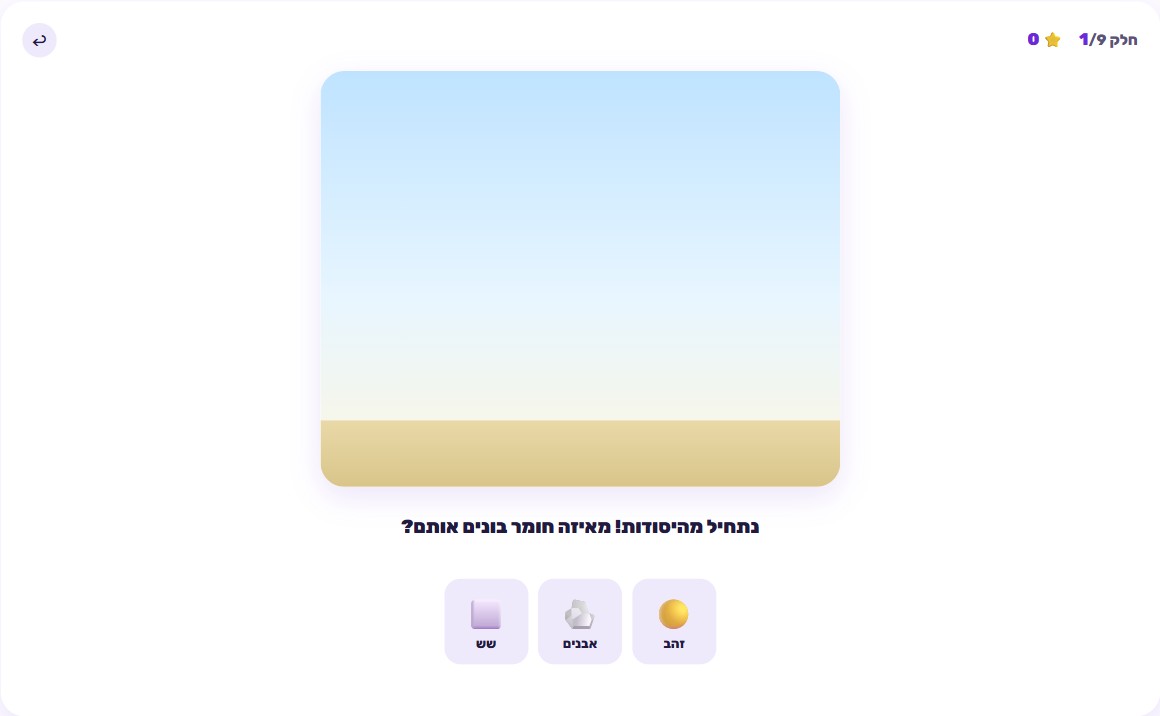
🎯 How to play
- Pick a mode - Relax with no timer and no lives, or Challenge with a timer and 3 hearts.
- Each level shows one part of the Temple (foundation, walls, outer altar, laver, menorah, table, incense altar, curtain, ark) with a list of materials to choose from.
- Tap the correct building material among the options shown.
- A correct pick reveals that part of the Temple and shows a real fact about it, with its source.
- In Challenge mode, answer before the timer runs out - a wrong pick or running out of time costs a heart out of three.
- Complete all 9 parts to finish the Temple and see your final score.
Why we built a game about the Temple
Learning about the Holy Temple - the sacred structure that once stood in Jerusalem - is a meaningful part of Jewish education, but that kind of learning usually stays on paper: a picture in a textbook, a paragraph to read, an explanation from a teacher. The problem with learning that way is that it stays abstract. The Temple had many different parts, and each one served its own purpose - and when you read through a list like that, it’s easy to forget which part did what within a day or two.
This game exists to solve exactly that problem. Instead of reading a list of names, you actually “build” the structure part by part, and each part gets its own moment where you have to decide what’s correct. The idea is simple: when you learn something by doing, rather than by passively reading, it tends to stick better over time. That’s not a new insight - it’s the same reason there’s a real difference between reading about something and practicing it yourself.
It’s worth saying clearly: this game doesn’t try to be a full textbook or a halachic source. It’s a playful tool that gives a first, friendly introduction to the Temple’s general structure and the names of its main parts, and it’s meant to invite further learning from qualified sources - a teacher, a book, a parent. What it does offer is a pleasant way in: a way to get familiar with the names and the overall structure without it feeling like a lesson.
How the game works: from one material to a whole building
The game is built from nine levels, and each level represents one part of the Temple: the foundation, the walls, the outer altar, the laver, the menorah, the table, the incense altar, the curtain, and the ark. The levels come in a fixed order, so the structure on your screen grows gradually from level to level - much like a real building goes up layer by layer.
Each level asks one question: which building material fits this part? Alongside the question you’ll see a few options - some correct, some distractors designed to look plausible without being the right material. Your job is simply to tap the correct material among the choices. This isn’t a test of memorizing dates or numbers - it’s a short, focused question that invites a moment of real thought before you pick.
What happens after your pick is the more interesting part: if you picked correctly, that part of the Temple is revealed and joins the structure being built on screen, and a real fact about that part appears - along with its source. In other words, the game doesn’t just check what you know; it also teaches you something new every time you’re right, and gives you the source so you can look further into it yourself if you want. That’s the difference between a quiz that only measures knowledge and a game that builds knowledge as you play.
Why “picking correctly” teaches more than reading alone
There’s a well-known learning principle called active recall: when you try to retrieve an answer yourself - even if you get it wrong along the way - your brain processes the information more deeply than when you simply read it and move on. It’s the same reason flashcards outperform re-reading the same page of notes, and it’s the exact principle behind this game’s format: instead of reading “the menorah is made of gold,” you’re asked to pick it out yourself from a few options - and that act of deciding, even when the first guess is wrong, is what makes the information stick.
Another advantage of this format is immediate feedback. Instead of waiting to check your answers at the end (like a written test), you find out right away whether you were correct, and you get the explanation while the question is still fresh in your mind. Immediate feedback like this is one of the most effective tools in learning, whether it’s a foreign language, math, or - as here - getting to know a historical structure and what each of its parts was for. That’s exactly why quiz-and-learn formats like this one are widely used in classrooms, not just as entertainment.
Relax mode and Challenge mode - how to use both well
The game offers two modes, and it’s worth using them in the right order. Relax mode is the natural place to start: there’s no timer and no hearts, so a wrong pick just shows a gentle message inviting you to try again - no pressure, no “losing.” This is the right mode for a first pass through the nine parts of the Temple, when the goal is just to learn the names and the order without any fear of getting something wrong. Scoring here is gentle to match: 5 points for every correct pick, plus a 10-point finish bonus once you complete every level.
Once the overall structure feels familiar - once you can more or less remember which material goes with which part - that’s the perfect time to switch to Challenge mode. Here you only get 3 hearts, and every level has its own countdown timer: the time available grows the more correct answers you’ve already stacked up in a row (a base of 6 seconds plus 4 more seconds for every correct pick you’ve already made), so the game essentially adapts to your pace. A wrong material pick, and running out of time without picking at all, both cost one heart - and losing all 3 hearts ends the game. Scoring is higher to match the added pressure: 10 points per correct pick, plus a finish bonus based on how many hearts you have left - each surviving heart is worth 10 bonus points. That means finishing Challenge mode without losing a single heart earns you the biggest bonus of all.
That order - Relax first, then Challenge - isn’t arbitrary. Trying to learn nine new parts while a timer and hearts are both pressing on you at once is a recipe for frustration, not learning. But once the basics are solid, Challenge mode becomes an excellent way to test how much really stuck - which is exactly the active recall described above, just with a bit more adrenaline.
Similar games on the site worth trying
If you enjoyed combining Jewish learning with a game, try Which Blessing? next - you see a food and pick the right blessing, with an explanation after every answer, much like the sourced facts that appear here after every correct pick. You can also try Blow the Shofar, which teaches you to tell apart tekiah, shevarim and teruah through hands-on play. And if you like the quiz-with-sources format, Mishnah Quiz offers exactly that, based on Mishnah tractate Rosh Hashanah.
🧠 Test Yourself
Answer all three questions correctly to earn 100 stars!
Frequently Asked Questions
What's the difference between Relax mode and Challenge mode?
Relax mode has no timer and no hearts - a wrong pick just shows a gentle message inviting you to try again, with no penalty. Challenge mode gives you 3 hearts and a per-level timer; a wrong pick or running out of time costs a heart, and losing all 3 hearts ends the game.
How many parts of the Temple do you build in the game?
Nine: the foundation, the walls, the outer altar, the laver, the menorah, the table, the incense altar, the curtain, and the ark. Each part is its own level with its own building-material question.
Does the game actually teach real facts about the Temple?
Yes - every correct pick reveals a real fact about that part along with its source, so the game works as a learning tool and not just a quiz.
Who is this game for - is there an age limit?
It works for every age. Relax mode is a gentle first introduction to the structure, even for younger kids, while Challenge mode with its timer suits anyone who already knows the parts and wants a real test.