
🃏
Shop Builder: A Family Card Game Guide
Shop Builder is a card game: collect 6 shop pieces while dodging Thief cards, and use Police and Coin cards to defend or trade. Rules and tips inside.
▶️ Play Now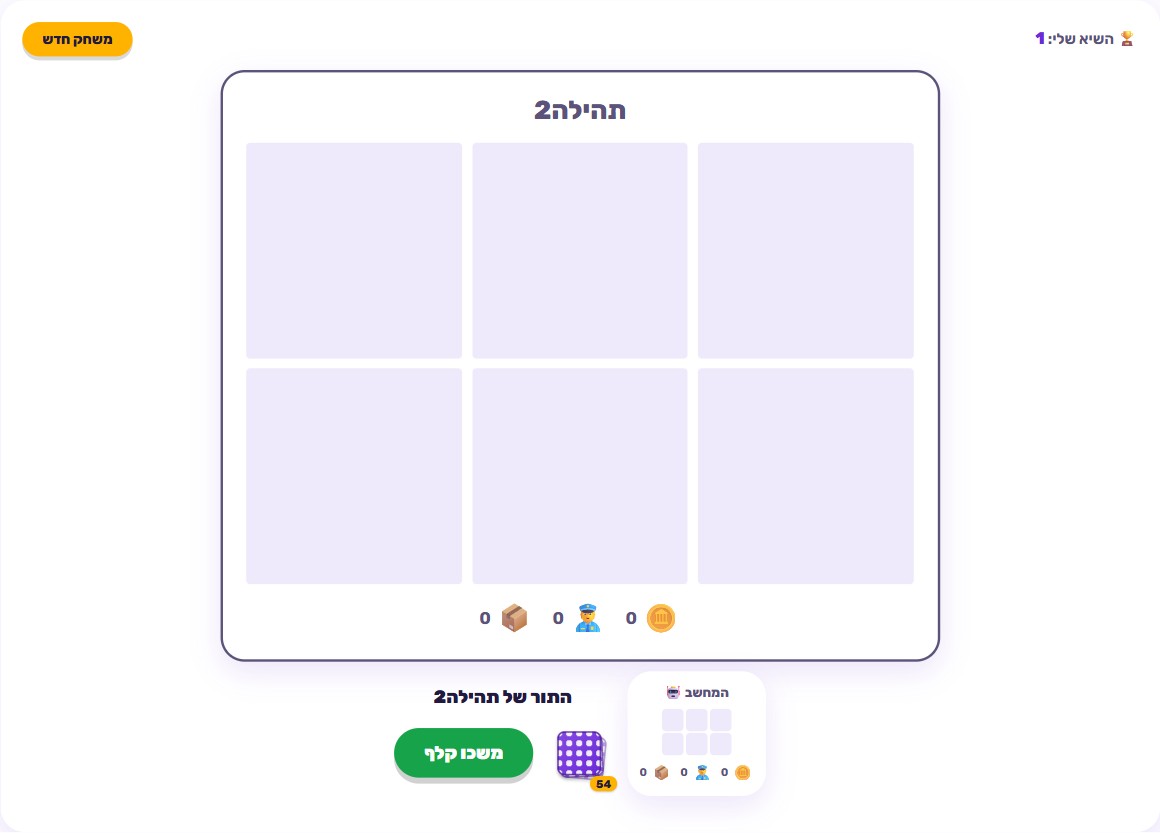
🎯 How to play
- On your turn, draw one card from the shared deck.
- Collect shop-item pieces - you need all 6 to win.
- A Thief card steals 3 pieces back into the deck, unless someone holds a Police card to block it.
- A Coin card lets you buy a piece you need from a rival for 3 coins.
- Play solo against one computer opponent, or with up to 4 players total.
- The first player to complete all 6 pieces wins, and their finished shop is revealed with confetti.
What is Shop Builder
Shop Builder is a card game for 1 to 4 players who all draw from the same shared deck, racing to be the first to complete their own shop. Each player builds a shop out of 6 pieces - like puzzle fragments that together form one of 4 possible shop images. There’s no complicated board and no long rulebook: you draw a card, see what you got, and decide what to do with it. Play alone and the game automatically adds one computer-controlled opponent, so there’s never a wait for a second player to show up. Whoever reaches 6 pieces first wins, and their completed shop image is revealed on screen with a confetti celebration - a small, satisfying payoff that closes out every round with a clear sense of victory.
What makes Shop Builder interesting is that collecting pieces is only half the story. The deck also holds three kinds of special cards - Thief, Police, and Coin - that can flip the game state without warning. That means even when someone is one piece away from winning, there are still real ways to change the outcome. The game isn’t just about building a shop - it’s about reading the table, deciding when to act, and knowing when to hold back.
Why “collect a set while others can disrupt you” is a proven format
A structure where you collect a set of cards while other players can reach in and disrupt what you’ve already gathered is one of the oldest and most successful formats in family card games. The reason is simple: when a rival can “touch” your progress even when it isn’t their turn, every player stays engaged through the whole round - not just during their own turn. In many card games, players lose interest waiting through a long turn where nothing happens to them; when a Thief card can cause chaos at any moment, everyone at the table stays alert, because the situation can flip without notice.
That same structure is also what makes a fairly short game replayable without ever feeling repetitive. Because the order cards come up in changes every round, and because each player has to decide in real time whether to play a special card or hold onto it, no two rounds feel quite the same. This is the exact principle behind many classic family card games across generations: simple rules anyone can learn in a minute, backed by a layer of decision-making that gets sharper the more you play.
How it actually plays out
The basic rules are easy to explain: on your turn, you draw one card from the shared deck. If it’s a regular shop-piece card, it joins your collection. The goal is to reach exactly 6 pieces - no more, no less - and whoever gets there first declares victory as their full shop image is revealed instantly with confetti on screen. Alongside the regular piece cards, the deck also holds three special cards that can turn up on any draw: Thief, Police, and Coin. Each one forces an immediate decision from the player who draws it, and sometimes a reaction from everyone else too.
Player count is flexible: you can play entirely alone (the game then adds one computer player automatically), or with up to 4 real players sharing the same screen. Both modes use the exact same rules - the only difference is how stars are counted at the end, which we cover below.
Thief, Police, and Coin cards - the strategic heart of the game
The three special cards are what separates Shop Builder from a plain collect-and-draw game where you never have to think twice.
The Thief card is the one everyone fears: playing it steals 3 shop-item pieces back into the deck - pulling them away from whoever had already collected them. It can hit at the exact moment you were closest to winning, which is why the Thief card creates most of the game’s tension. But there’s a way to defend against it.
The Police card’s job is to block one Thief card from taking effect. A player holding a Police card when someone tries to play a Thief can stop the theft completely. This creates a real strategic choice: play the Police card the moment you draw it, or hold it in reserve as “insurance” in case someone tries to steal from you exactly when you’re close to finishing? Experienced players learn to keep a Police card in hand precisely when they have a lot of pieces - that’s the moment there’s the most to lose.
The Coin card works completely differently: it doesn’t defend, it buys. If you’re missing exactly one piece to finish, and a rival happens to have it, a Coin card lets you buy that missing piece from them for 3 coins. The question is whether it’s worth it - spend a coin now to speed up a win, or wait and hope you draw the piece yourself for free on a later turn. That decision is exactly where the game shifts from “luck of the draw” to genuine judgment.
Solo vs. computer versus multiplayer - two modes, two scoring rules
Shop Builder offers two very different modes when it comes to what happens after a win. In solo mode against the computer, the game tracks a win streak: every win adds one to the streak and earns 25 stars plus 3 more stars for each win in the current streak - so a long streak pays off more than any single win on its own. But a single loss resets the streak all the way back to zero. Your best score in this mode is the longest streak you’ve managed, not your total number of wins.
In multiplayer (2 to 4 real players sharing the same screen), scoring is simpler: every win is worth a flat 20 stars, with no streak tracking at all. That makes sense - when you’re playing against real friends, the tension is already in the room, and there’s no need for a streak system to keep things interesting.
There’s also a unique achievement tied only to solo mode: the “Shop Builder Champion” avatar unlocks after winning 3 games in a row against the computer. Important to know - this achievement can’t be unlocked in multiplayer, even if you win several times in a row there. Anyone chasing this avatar needs to specifically choose solo mode and keep a clean streak of 3 wins.
Real tips for winning more often in solo mode
- Track how many pieces you’re missing, not just how many you have. The gap between 4 and 6 pieces feels small, but the gap between 5 and 6 is critical - that’s the moment a Thief card hurts the most, and also the moment a Coin card is most worth considering.
- Hold a Police card when you’re close to winning. With 5 out of 6 pieces, a Police card in hand is the most valuable insurance you can carry. Don’t rush to play it just because you drew it - wait for the moment it actually matters.
- Don’t spend a Coin card just because you can. A Coin card is worth the most when it closes out your very last missing piece. If you’re still missing 3 or 4 pieces, it’s usually better to wait and see what comes up on later turns.
- Watch how close the computer opponent is. If the computer is close to winning, that’s the moment to consider playing a Thief card of your own if you’re holding one - sometimes the best defense is a well-timed offense.
- Build your streak before chasing the avatar. Unlocking Shop Builder Champion needs exactly 3 wins in a row - a loss in the middle resets everything. Play with extra focus during the stretch where you’re building toward that streak.
Similar games on the site worth trying
If you enjoyed the mix of strategy and luck in Shop Builder, check out Dots and Boxes - a game where every small move you make can open an opportunity for your opponent, much like a Thief card waiting for the right moment. If you like planning moves several steps ahead, Connect Four will keep you thinking not just about your next move but about what your opponent might do next. And for a classic challenge against a real opponent (or the computer), Checkers is a proven, timeless choice that suits every age.
🧠 Test Yourself
Answer all three questions correctly to earn 100 stars!
Frequently Asked Questions
What's the goal of Shop Builder?
Be the first to collect all 6 pieces of your shop - jigsaw-style fragments of one of 4 possible shop images. Whoever completes all 6 pieces wins, and their finished shop is revealed with a confetti celebration.
What do the Thief, Police, and Coin cards do?
A Thief card steals 3 shop-item pieces back into the deck - unless another player plays a Police card to block it. A Coin card lets you buy a piece you're missing from a rival for 3 coins. These three special cards are what turn every turn into a small moment of tension.
What's the difference between solo and multiplayer mode?
In solo mode against the computer, you build a win streak: each win adds to the streak and earns 25 stars plus 3 more per streak win, while a loss resets the streak to zero. In multiplayer (2-4 real players), every win is worth a flat 20 stars, with no streak tracking at all.
How do you unlock the Shop Builder Champion avatar?
Win 3 games in a row in solo mode against the computer. This achievement only counts in solo mode - winning several times in a row in multiplayer doesn't unlock it.