
🃏
Pong Game Guide: How to Beat the Computer
Pong is the classic two-paddle screen game against the computer, first to 5 points wins. Real tips for beating its imperfect AI and scoring a shutout.
▶️ Play Now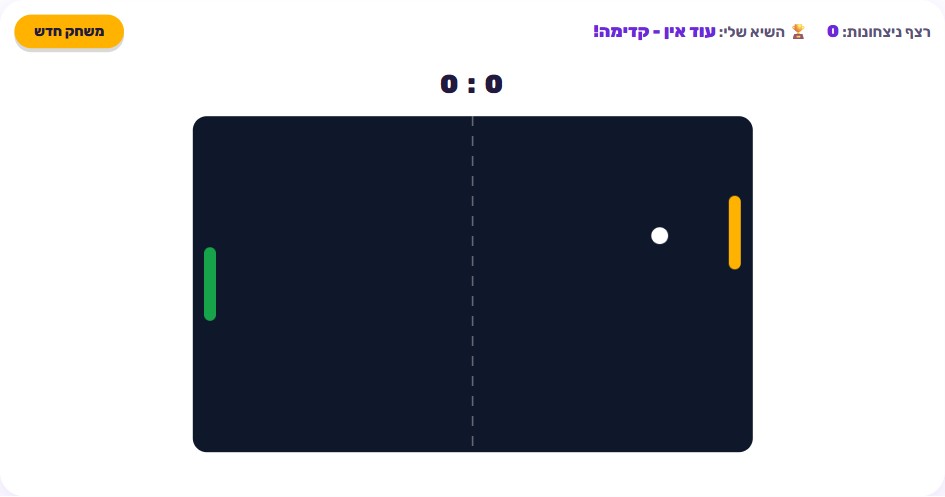
🎯 How to play
- Move your paddle up and down to intercept the ball before it slips past you.
- Every time the ball hits your paddle, it bounces back toward the computer, and vice versa.
- Track the ball itself, not the computer's paddle - that gives you a better read on where to be.
- Every ball the computer misses gives you a point, and every ball you miss gives it one.
- Whoever reaches 5 points first wins the match.
- Win 5-0 without letting the computer score a single point, and you unlock the 'Pong Champion' avatar.
Where Pong actually comes from
Pong isn’t just another screen game - it’s one of the most influential games ever made. The original was released in 1972 by Atari, and it’s widely credited as one of the first commercially successful video games in history. The idea was almost absurdly simple: a dark court, two straight paddles on opposite sides, and a square ball bouncing between them. No characters, no story, nothing beyond basic physics of hitting and returning - and yet it caught on instantly, drawing lines of players around arcade cabinets everywhere.
Pong’s success wasn’t a footnote. It genuinely helped launch the entire video game industry as we know it today - from coin-operated arcade cabinets to the first home consoles that brought the same idea into living rooms. Playing the digital version of Pong on this site means touching a real piece of gaming history, not a distant homage - the exact same mechanism that started it all: two paddles, a ball, and a win earned through precision and focus alone.
What’s remarkable is how little that core mechanism has changed. Games come and go constantly, but the idea of “stop the ball before it gets past you” has stayed relevant for more than fifty years, simply because it was built right from the very first version.
Why a game this simple stays this fun
There’s a well-known game design principle called “easy to learn, hard to master,” and Pong might be the purest example of it that exists. There are no rules to explain, no menus to figure out, no hidden mechanics - you see a ball, you move a paddle, and that’s the whole game. A five-year-old can start playing within two seconds, with nobody needing to explain a single thing.
But real depth hides underneath that simplicity. Once the ball starts moving faster, every paddle movement has to be precisely timed. There’s little room for big mistakes - one miss costs a point, and five points decide the whole match. That’s exactly why simple reflex-and-timing games like Pong stay fun after dozens of rounds: every match plays out a little differently, every ball demands a fresh reaction, and there’s no way to “solve” the game once and be done with it. It’s also what makes it work for every age - there are no separate difficulty tiers, because the game calibrates itself through the pace it creates.
The price of that simplicity is also its biggest strength: there are no distractions. No side puzzle, no items to collect - just you, a paddle, and a ball. It’s exactly the kind of game you can play for five minutes on a break and keep coming back to without ever losing interest.
Real tips for actually beating the computer
The computer opponent in Pong doesn’t play perfectly, and that’s an important thing to understand. Its paddle tracking has a built-in wave-shaped error, meaning its accuracy rises and falls in a rhythm instead of staying constant the whole time. In practice, that means the computer is beatable, but not easily - it’s not a mindless wall you can coast past, but it’s not unbeatable either.
A few real tips that follow directly from how the AI actually behaves:
- Hit the ball at sharp angles, not just straight back. Because the computer’s tracking isn’t perfect, a ball arriving at a steep angle forces it to correct its paddle position faster - exactly the moment its built-in error shows up most.
- Vary where you place your shots. If you always return the ball to the same spot, the computer effectively “adapts” to that zone. Mixing up your shot placement forces it to react to a less predictable pattern.
- Pay attention to rhythm, not just position. The computer’s error is cyclical - if you notice when it tends to miss more, you can time your decisive shots for exactly those moments.
- Don’t rush every return at full speed. Good timing beats raw reaction speed - a paddle that arrives right on time controls the return direction far better than a rushed, last-second swing.
- Play several matches back-to-back to “read” the pattern. Just like any opponent with a rhythm, the more matches you play in a row, the better you’ll get at spotting when the computer is weaker.
There are no separate difficulty levels in this game - every match is the same challenge, and the only real variable is how well you read your opponent’s rhythm.
Scoring, your best streak, and the “Pong Champion” avatar
Your best score in Pong is measured by your longest win streak - how many matches in a row you can win without a loss breaking the chain. Each individual win earns you points on a simple formula: 15 base points, plus 3 more for every win you’ve already stacked up in your current streak. That means a long streak isn’t just satisfying to watch grow - it’s worth more points, since every additional win in the streak raises the value of the next one.
Beyond regular scoring, there’s a special achievement called Pong Champion: to unlock this avatar, you need to win a complete match with a shutout - finishing 5-0, without the computer managing to score even a single point against you. That takes more than just winning; it takes a fully clean run from start to finish, where every ball the computer sends has to come back. It’s a genuine challenge, because even a match you’re winning comfortably can slip for one moment if your timing wobbles.
That combination - streak-based scoring plus a shutout-based achievement - turns Pong into more than a one-off game. There’s a real reason to keep coming back: to beat your own personal streak, and to chase that perfectly clean shutout win again and again.
Worth clarifying: this isn’t table tennis, and it isn’t beer pong
The word “pong” gets a little confusing, and it’s worth being upfront about it. Sometimes people search for “pong” meaning real table tennis - paddles, a small ball, a table with a net. And sometimes “pong” in a totally different context refers to a party drinking game with cups, which has nothing to do with a video game at all.
The game on this site is neither of those. It’s the original classic Pong - the abstract digital game from 1972, with two straight paddles on a dark screen and a square ball bouncing between them, exactly like the version that kicked off the entire video game industry. There’s no table tennis physics with spin and topspin, and no connection to any party drinking game. This is the original, simple, clean version, exactly as it appeared on the very first arcade cabinets.
Similar games on the site worth trying
If you enjoyed the fast head-to-head pace of Pong, check out Rock Paper Scissors - another quick classic against the computer that’s all about reading patterns, much like returning shots in Pong. If you like the tension of racing to be first to win, Tic-Tac-Toe offers that same short, direct duel feeling in a different format. And if you’d rather trade Pong’s fast reflexes for a slower, more calculated challenge, Checkers gives you a deeper strategic duel against the computer with the exact same goal: outplay your opponent.
🧠 Test Yourself
Answer all three questions correctly to earn 100 stars!
Frequently Asked Questions
Is this a table tennis simulator, or beer pong?
No. This is classic arcade Pong - two straight paddles and a square ball on a dark screen, just like the original 1972 game. There's no table tennis physics and no connection to the drinking game with cups.
How many points does it take to win a match?
Five. Whichever side, you or the computer, reaches 5 points first wins the match, and a new round starts right away.
What's the 'Pong Champion' avatar and how do I unlock it?
It unlocks when you win a match with a total shutout - winning 5-0 without the computer scoring even once. That takes a completely clean run from the first point to the last.
How is my best score calculated?
Your best score is your longest win streak - how many matches in a row you can win without a loss breaking the chain. Each win also earns points: 15 base points, plus 3 more for every win you've already stacked in that streak.
Does the computer opponent play perfectly?
No. Its paddle tracking has a built-in wobble, so it's beatable - just not easily. It's not purely random either; it follows a rhythm you can learn and exploit.