
⚡
Memory Game Guide: How to Play and Win
The Memory Game is flipping cards to find matching pairs using only your memory. This guide covers the rules, difficulty, and tips for a faster time.
▶️ Play Now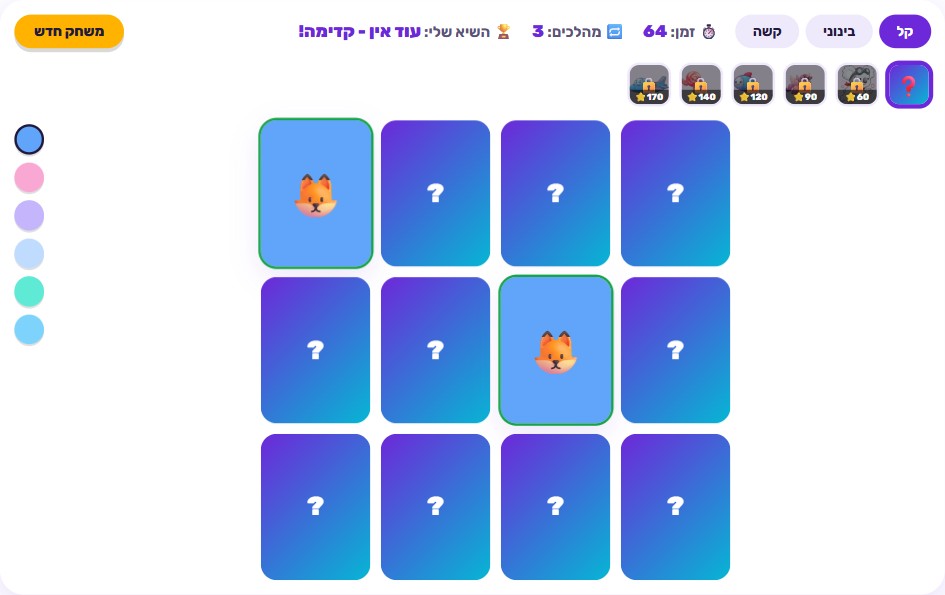
🎯 How to play
- Click any card to flip it face-up for a moment, then it flips back down.
- Try to remember which tile held which picture - that's the entire game.
- Click two cards in a row. If the pictures match, that pair stays revealed and disappears from the board.
- If the pictures don't match, both cards flip back down after a moment and you try again.
- The round ends once every pair has been found. The clock runs the whole time - the faster you finish, the better your record.
Where does this memory game come from?
Flipping cards to find matching pairs is one of the oldest and simplest card games in the world, known under different names in different places - “Concentration” in English, or “Pexeso” in its European name, a version especially popular across Central Europe in the 20th century. The idea has always stayed the same: a row of face-down cards, and visual memory is the only tool you get. Because the rules are so simple - no reading, no math, no shared language required - this game became one of the most universal family games there is: it works equally well for a preschooler and a grandparent. Our digital version keeps that exact same principle - no physical cards to lose or bend, but the same mental challenge, available the moment you open the page.
Why it’s more than “just a game” - what it actually trains
Pair-matching memory games are used in preschools and elementary schools as a tool for practicing working memory - the ability to hold several pieces of information in mind at once and use them. Every time you flip a card and remember its position, you’re training exactly that skill. That’s why the game is popular not only as entertainment but as an educational activity too - it requires no prior knowledge, just attention and patience.
Beyond memory itself, the game also trains sustained focus: on Hard mode with 12 pairs, a full round can take a few minutes, and the whole time you need to hold dozens of positions in mind at once. Kids who struggle to sit through one long task often do well with this game’s short, clear structure - every turn is a small, immediate decision, but the cumulative result demands persistence.
Which difficulty fits who
Easy mode (6 pairs, 12 cards) is the natural starting point for younger kids or anyone playing for the first time - a small board is easy enough to remember without much strain, and it builds confidence quickly. Medium (8 pairs, 16 cards) is the most popular sweet spot - enough challenge for memory to really kick in, without a round dragging on too long. Hard mode (12 pairs, 24 cards) is a serious challenge even for adults: the board widens to 6 columns, and at that point the difference between a good time and a bad one is almost always scanning strategy, not luck.
Real tips to beat your best time
- Scan systematically, not randomly. Beginners click cards in random order. Strong players scan the board in a fixed order (row by row, for example) so it’s easier to “map” where each picture is in memory.
- Remember the second card even when it’s not the match you’re currently chasing. Sometimes you flip a card that isn’t relevant to the pair you’re hunting right now - don’t throw that information away, it’ll help you a few turns later.
- Start on Easy. 6 pairs is a good way to learn the game’s rhythm before jumping to Hard mode’s 12 pairs, where a weak memory really shows.
- Play several rounds in a row. With most memory games, after a few rounds you start “recognizing patterns” in the layout - it sounds odd, but it works; your brain adapts to the game.
- Chunk the board into sections mentally. Instead of remembering 24 cards as one long list, try thinking of the board as four or six small “zones” - it’s easier to remember a position within a small zone than one position out of a whole board.
- Don’t rush to click the second card. There’s a brief moment between flipping the first card and the second where you can reinforce what you saw in memory - players who rush too fast often forget exactly what they just revealed.
Variations worth knowing about
Physical versions of the memory game (with real cards) have a few common variants worth knowing, even though they’re not part of this digital version: sometimes it’s played in turns between two or more players, with each player collecting the pairs they find; sometimes the number of attempts is capped instead of measuring time. This site’s version deliberately chose time-against-your-personal-best, because it fits a fast, solo game better - there’s no need to wait for a second player to enjoy the challenge.
Similar games on the site worth trying
If you enjoyed the mental challenge of the memory game, check out Flash Quiz - a fast trivia quiz racing the clock, which exercises a different kind of quick thinking. If you specifically want to practice remembering numbers, Number Grid trains focused recognition rather than visual memory. And if you’d rather face a real opponent instead of just the clock, Tic-Tac-Toe is a classic, quick choice.
🧠 Test Yourself
Answer all three questions correctly to earn 100 stars!
Frequently Asked Questions
Is the memory game free to play?
Yes, it's completely free and runs right in your browser - no sign-up and nothing to download.
How many pairs of cards are on the board?
It depends on the difficulty you pick: 6 pairs (12 cards) on Easy, 8 pairs (16 cards) on Medium, and 12 pairs (24 cards) on Hard.
How is a win decided?
There's no opponent - the game is scored by time. Every pair has to be found, and your clock keeps running until then. Your personal best is the fastest time you've managed to clear all the pairs.
Is this game just for kids, or can adults play too?
It works for every age. Hard mode with 12 pairs needs real working memory and gives adults a genuine challenge too.