
🃏
Pool Game Guide: Rules, Modes & Tips
Pool is a real physics billiards game: aim the cue and pot every ball. Two modes - Classic Pool and Snooker - plus real strategy tips to win more.
▶️ Play Now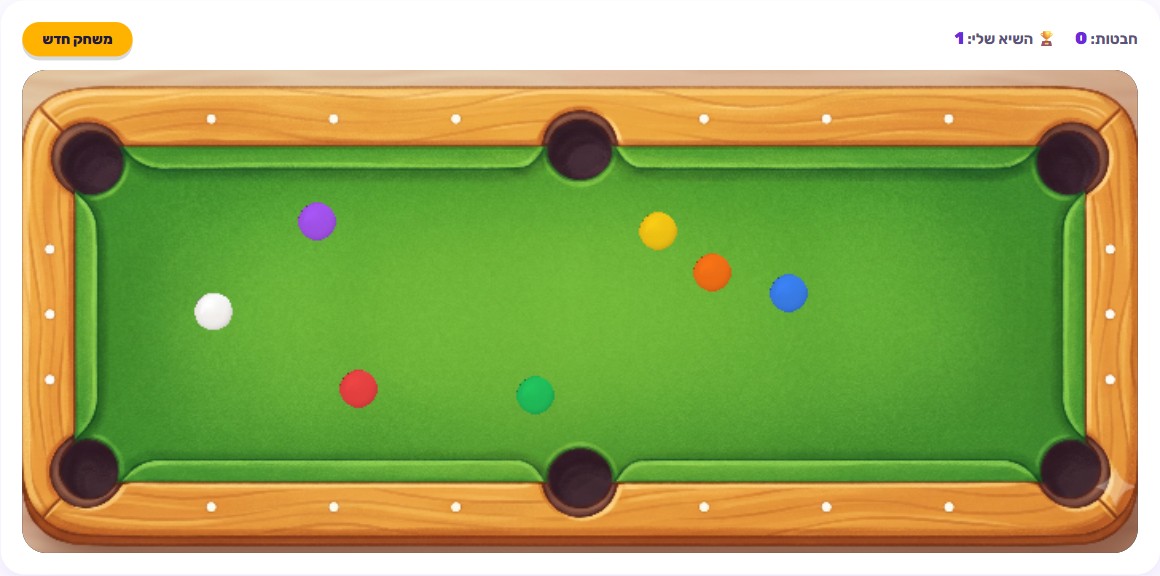
🎯 How to play
- Pick a mode first: Classic Pool or Snooker, before your first shot goes anywhere.
- Aim the cue at the cue ball - the direction decides where the colored balls scatter.
- Control your shot power: too hard scatters the balls with no control, too soft loses precision.
- In Classic Pool, pot balls into any pocket in any order; in Snooker, follow the correct order - reds first, then colors.
- After every shot the table updates and your next turn begins - no clock, no lives, just shot after shot until the table clears.
Where does the game of pool come from?
Billiards is one of the oldest and best-documented skill games in Europe. Its origins are documented going back several centuries, long before it had a felt table and pockets - the earliest versions were actually a lawn game, closely related to croquet, played outdoors with sticks and balls on grass. Over time the game “moved indoors”: it was transferred to purpose-built tables, gained rails so the balls wouldn’t roll off the edge, and eventually gained pockets to sink the balls into.
That shift produced two separate families of cue games: “pocket billiards,” known today simply as Pool, and pocket-less variants that stayed closer to the original game. Around the same time, a newer and more complex variant called Snooker developed in England during the 19th century, adding color rules and a strict potting order. These three branches - billiards, pool, and snooker - still exist side by side today, each with its own rules, its own following, and its own organized competitions.
Pool vs. Snooker - two different worlds
To a casual player, “billiards” and “pool” usually describe the same basic experience: a table with six pockets, a set of colored, numbered balls, and a cue ball you strike to pot the rest - in whatever order is convenient. That’s exactly why the game is so popular socially: the rules take a minute to explain, and you don’t need to be an expert to enjoy it.
Snooker is a different story altogether. It’s a far stricter competitive discipline, with precise scoring rules: you must pot a red ball first, and only then a colored ball in a fixed scoring order, repeating until every red is gone. That structure makes snooker a much more strategic, more complex game - a strong player isn’t just aiming to pot one ball, but planning several shots ahead. Snooker holds an especially high competitive status in the United Kingdom, where it’s broadcast on television as a full sport, with long-running world championships and internationally recognized players. Our digital version lets you choose between both worlds on the same screen - Classic Pool for a quick, relaxed game, and Snooker for anyone who wants the more structured, more demanding challenge.
How it works in our game - modes, scoring, and the champion badge
Our game gives you two modes to pick from, each with its own scoring rules. Classic Pool is the simpler mode: the goal is to clear every ball off the table in as few shots as possible. Your best score is measured by how many shots (shots taken) it took you to finish - fewer is better. The points you earn are calculated with a simple formula: start from 50 points, subtract 3 points per shot and 5 more points per foul, but never drop below 10 points - so even a rough table still leaves you with a minimum score.
Snooker, on the other hand, is a points-based mode: the goal is to build up as many points as possible by potting reds and colors in the correct order. Your best score is the highest point total you reached during the game, and the points you earn at the end are double that total (with the same 10-point floor as Classic Pool).
Worth knowing: there’s no clock counting against you here and no lives system - it’s a quiet, shot-by-shot game at your own pace. If you commit a foul or accidentally sink the cue ball (a scratch), an on-screen message explains exactly what happened, and play simply continues - no dramatic penalty beyond the score hit.
There’s also a special avatar to unlock: “Pool Champion.” To earn it, you need to clear an entire table in Classic Pool mode (not Snooker) in 8 shots or fewer - a reachable target once you’ve practiced a bit, but one that takes real control rather than luck. It can’t be unlocked through Snooker mode, since that mode is measured in points, not shot count.
Real strategy tips to play better
- Think ahead, not just about the next shot. Beginners only think “how do I pot this ball.” Strong players also think about where the cue ball will end up after it hits the object ball - that position decides how easy your next shot will be.
- Start with straight shots before angled ones. A straight shot, where the cue ball, the object ball, and the pocket sit close to the same line, is far easier to control than a sharp angle. When you have a choice between two options, take the straighter one first.
- Control your power - don’t always hit hard. Too much power sends the cue ball flying after contact and makes your next shot harder, sometimes even causing a foul. A measured, gentler shot gives you much better control over the outcome.
- Watch for fouls before you shoot. In Snooker especially, potting the wrong ball out of order is a foul that costs you points - before every shot, make sure you know which ball you’re actually allowed to pot next.
- Practice Classic Pool first. Its simpler rules help you build a feel for distance and angle before moving on to Snooker’s stricter potting order.
Why pool is more than just a fun game
Beyond entertainment, pool is excellent training for geometric thinking: every shot is really a real-time angle calculation - the angle of contact, the angle the ball will continue on, and the distance to the pocket. That’s exactly why pool is filed under our “thinking” category rather than just “fun” - it works for every age precisely because there’s no luck involved: every outcome comes from real physics that the game’s engine (Phaser) simulates accurately, so the same shot always behaves the same way. That’s also what makes practice genuinely effective - improve your angle or your power, and you’ll see the result improve consistently, not randomly. It’s exactly why the game suits kids who are just starting to grasp geometry, and adults looking for a quick challenge with no opponent required.
Similar games on the site worth trying
If you enjoyed the mix of strategy and skill in pool, check out Checkers - a classic thinking game that demands planning several moves ahead, much like a good shot in pool. If you like thinking in sequences rather than just the next move, Connect Four is a great fit, where every move can open or close a future opportunity. And if you want a quick, light challenge against an opponent, Tic-Tac-Toe is a perfect warm-up before a round of pool.
🧠 Test Yourself
Answer all three questions correctly to earn 100 stars!
Frequently Asked Questions
What's the difference between Classic Pool and Snooker in this game?
In Classic Pool you pot every ball into any pocket in any order, aiming to clear the table in as few shots as possible. In Snooker you must pot a red ball first and then a colored ball, in a strict order, and you build up points instead of counting shots.
What happens on a foul or scratch (sinking the cue ball)?
An on-screen message explains what happened, and play just continues. There's no lives system and no timer - just a small hit to your score for the foul.
How do you unlock the 'Pool Champion' avatar?
Clear an entire table in Classic Pool mode (not Snooker) in 8 shots or fewer. It's a reachable goal once you've had some practice, but it takes real control, not luck.
Is this online pool game free to play?
Yes, completely free and playable right in your browser - no sign-up, nothing to download, and both modes, Classic Pool and Snooker, are included.