
🃏
Math Race Game Guide: Rules and Streak Tips
Math Race is a math game against the clock for elementary kids - a correct answer keeps a streak alive. This guide covers difficulty and the Champion badge.
▶️ Play Now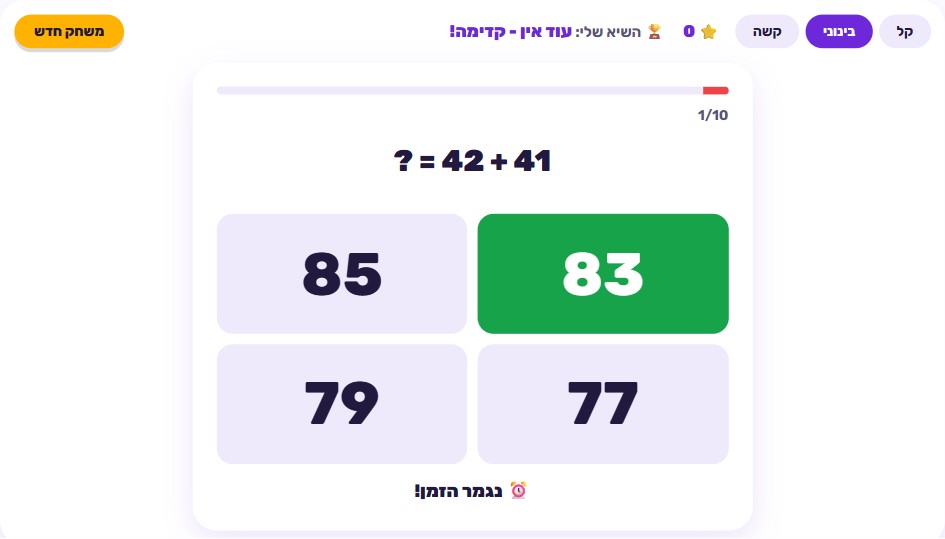
🎯 How to play
- Pick a difficulty level: Easy, Medium, or Hard.
- Every question comes with a countdown timer - answer before time runs out.
- Choose the correct answer from four multiple-choice options.
- A correct answer keeps your streak alive and adds stars. A wrong answer or a timeout resets the streak.
- Finish all the questions in the round - a perfect score earns a bonus.
- Keep a streak of 20 correct answers in a row to unlock the Math Race Champion avatar.
What is Math Race, exactly?
Math Race is a simple but intense math game: you get a problem, four possible answers appear as buttons, and a countdown bar ticks down while you think. The point isn’t to solve complicated equations - it’s to solve basic facts quickly, which is exactly what makes it a genuinely useful practice tool. Unlike most games on this site, which work for any age, Math Race is deliberately aimed at elementary-school kids - the age range where all four basic operations the game is built around are actually being taught and practiced. That doesn’t mean a younger kid can’t try Easy mode, but the Medium and Hard questions assume multiplication and division skills usually picked up a couple of grades in.
The game is built from three separate difficulty levels, and each one adds a layer: new operations, more questions, and less time to answer each one. That structure is intentional - it lets every kid start exactly where they’re comfortable and move up only when they’re ready.
Why timed math-fact practice actually helps
There’s a well-established educational idea called arithmetic fluency - the ability to retrieve the answer to a basic fact (like 7+5 or 6×4) instantly, without re-computing it from scratch every time. This isn’t just speed for speed’s sake. When a kid still has to “calculate” every basic fact from the ground up, all of their mental effort goes into that step - leaving nothing left over for the bigger problem the fact was supposed to serve (a word problem, a fraction, a multi-step equation). Once basic facts become automatic, the brain is free to focus on the actual math concept instead of the mechanical arithmetic underneath it.
That’s exactly why practicing under a time limit - like in Math Race - is fundamentally different from practicing on a regular worksheet. A worksheet gives a kid unlimited time to reach every answer the long way (fingers, tally marks, counting backward). That’s fine early on, while the concept itself is still being learned, but at some point the goal shifts: not just “can you get to the right answer” but “do you know it instantly.” A 6-to-10-second timer forces exactly that shift. It isn’t harsh - it just leaves no room to fall back on slow manual counting, and nudges the brain toward finding the fast route instead.
It’s also worth understanding how the streak mechanic ties into motivation. In Math Race, every correct answer keeps a running streak alive - and any mistake or timeout resets it. That mechanic creates a natural incentive to slow down and focus, without needing to spell it out: a kid watching their streak grow simply wants to protect it. And that’s exactly the habit that matters most in math practice - consistent repetition, not one big burst of effort.
How scoring and the achievement actually work
Scoring is straightforward: every correct answer counts, and your final score is the number of correct answers out of the total questions in that round. The stars you earn depend on difficulty - 5 stars per correct answer on Easy, 8 on Medium, and 12 on Hard. The logic is simple: the harder the level (more operations, less time), the more each correct answer is worth. And if you finish an entire round without a single mistake, you get an extra 10-star bonus for a perfect run.
Beyond regular scoring, there’s a special achievement: the “Math Race Champion” avatar. Unlocking it requires 20 correct answers in a row - not 20 correct answers total, but 20 consecutive ones, with no mistake or timeout in between. The interesting detail is that this streak doesn’t reset when you switch difficulty levels within the same play session - so you could, for example, finish a strong streak on Medium and carry it straight into Hard without losing it. But any wrong answer, on any level, wipes it out instantly. That makes the achievement a genuine challenge: it isn’t measured by how much you’ve played, but by how long you can stay accurate without a single slip.
Real tips for answering faster without mistakes
- Learn the easy number pairs by sight. Pairs like 5+5, 6+4, or 8+2 all land on 10, and the brain learns to recognize them almost automatically. Once pairs like that jump out at you, the rest of the problem gets a lot easier.
- Use skip-counting instead of counting one by one. Instead of counting up from 7 to 12 one number at a time, jump in steps of 2 or 5 - it saves precious seconds while the timer is running down.
- For multiplication, lean on “anchor facts.” For example, 6×5 is easier to recall as “half of 60” than to calculate from scratch. Anchors like doubling and halving save a lot of time on multiplication problems.
- Don’t panic-guess when time is running out. As the timer drops, there’s a strong pull to click the first answer you see. It’s usually better to pause for a beat, rule out answers that are obviously wrong (like an odd result for two odd numbers added together), and then pick.
- Practice without the timer first, then add it back. If a particular operation - say, division - still feels shaky, it’s worth practicing it on a regular worksheet first, then trying it in Math Race once the clock is running.
- Treat the streak as its own goal, not just the score. Instead of focusing only on how many stars you’ve earned, try to see how long you can hold a mistake-free streak - that’s exactly the metric that unlocks the Champion avatar.
Which difficulty fits which stage
Easy mode (8 questions, 10 seconds each, addition and subtraction only) is the natural starting point for kids who are just learning addition and subtraction - typically first or second grade. Ten seconds is enough time to think without pressure, while still keeping the goal clear: answer quickly, don’t calculate slowly.
Medium mode (10 questions, 8 seconds each, adds multiplication) fits the stage where multiplication tables are being learned at school - usually around third grade. Mixing addition, subtraction, and multiplication under a faster timer pushes exactly the kind of multiplication-table practice that feels like a quick, fun quiz instead of a boring drill.
Hard mode (12 questions, just 6 seconds each, adds division) is meant for kids who’ve already been introduced to division - usually fourth grade and up. Six seconds is genuinely tight, and that’s the point: at this level the goal isn’t “eventually get it right,” it’s “know it instantly.” Struggling here is a good sign to drop back to Medium and practice a bit more before trying Hard again.
Moving between levels doesn’t have to be a strict one-way climb - it’s fine, even useful, to drop back to an easier level now and then just to rebuild a streak and feel a win, then come back to the harder level with renewed confidence.
Similar games on the site worth trying
If you like the mix of quick thinking and time pressure, try Number Grid - it trains number recognition and focus under time, in a style similar to Math Race but without any arithmetic at all. For a different kind of thinking challenge, Guess the Number trains numerical logic and deduction rather than speed. And if you enjoy the feeling of “racing the clock” but with letters instead of numbers, Typing Race is the natural next stop.
🧠 Test Yourself
Answer all three questions correctly to earn 100 stars!
Frequently Asked Questions
What age is Math Race meant for?
Unlike most games on this site, which suit any age, Math Race is aimed specifically at elementary-school kids who are already practicing addition, subtraction, multiplication, and division. Younger kids can still try Easy mode with an adult nearby.
Which operations show up at each difficulty level?
Easy mode uses only addition and subtraction. Medium mode adds multiplication on top of those. Hard mode adds division as well, alongside the other three operations.
What happens when you answer wrong or run out of time?
Your correct-answer streak resets completely. Your overall score - how many questions you got right out of the total - is not affected by the reset; only the running streak starts over.
How do you unlock the Math Race Champion avatar?
You need to build a streak of 20 correct answers in a row. That streak is tracked across every question you answer, even if you switch difficulty levels mid-session - but any wrong answer or timeout resets it completely.
How many questions are in each round, and how much time do you get per question?
Easy has 8 questions with 10 seconds each. Medium has 10 questions with 8 seconds each. Hard has 12 questions with just 6 seconds each.