
🃏
Which Blessing? Game Guide: How to Play
Which Blessing? has you pick the right blessing for 34 foods across six categories, from hamotzi to shehakol. Learn the rules and try Hard mode.
▶️ Play Now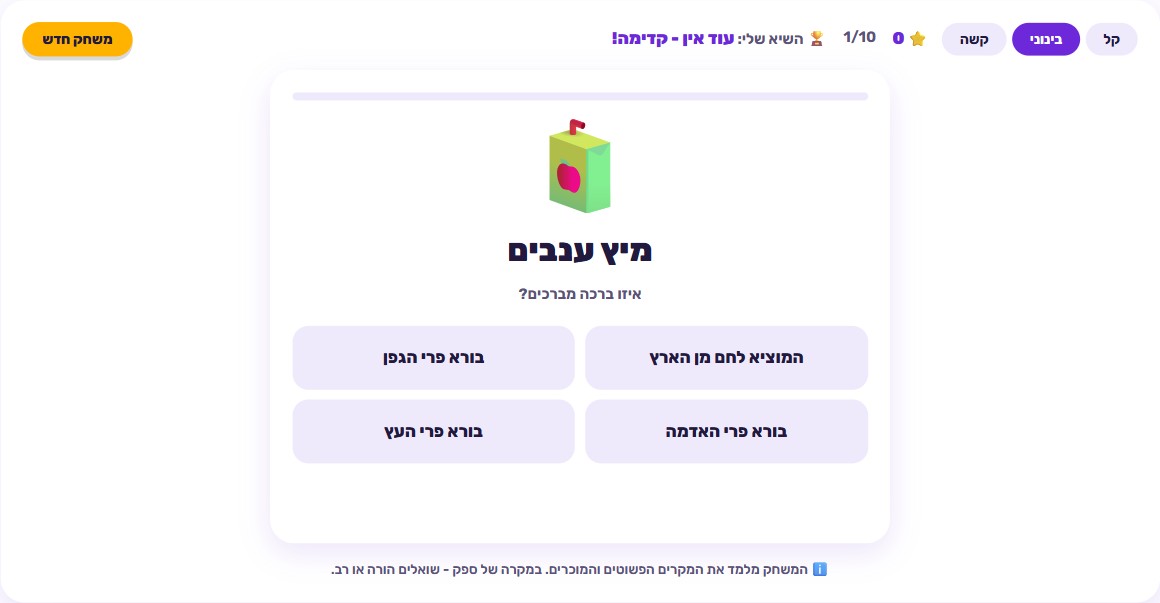
🎯 How to play
- The game shows you a food as an emoji with its name, and you pick the correct blessing from the options shown.
- Choose a difficulty: Easy gives you 2 answer choices, Medium gives 4, and Hard gives 6.
- Tap the blessing that you think is correct out of the options on screen.
- After every answer, read the explanation that appears - whether you got it right or wrong. That's the best way to actually learn the rules.
- Keep going through the round - 8, 10, or 12 foods depending on the difficulty you picked.
- Try Hard mode with a perfect score to unlock the Blessings Champion avatar.
What “blessings of enjoyment” actually means
Before eating almost anything - a piece of fruit, bread, a glass of grape juice, a snack - it’s customary to say a short blessing first. In Jewish law these are called birkat hanehenin, blessings said over the enjoyment of a food, and they’re different from the blessing said after eating (like birkat hamazon after bread, or the shortened al hamichya blessing after grain products, wine, or fruit from the seven species). The Which Blessing? game focuses specifically on that first part - the blessing said before you start eating - and doesn’t cover the after-blessing, which is a separate topic with its own set of rules. It’s worth being precise about this from the start, since the two are easy to mix up, and the game doesn’t claim to teach both.
The idea that a specific food gets a specific blessing, rather than one generic blessing for everything, is a basic, recurring part of daily Jewish life. Anyone eating a breakfast with bread, fruit, and something sweet already needs to know three or four different blessings just for that one meal. This isn’t trivia kept aside for a test - it’s a skill used every single day, several times a day, by anyone living an observant lifestyle. That’s exactly why this game is useful well beyond entertainment: it drills the actual decision you have to make in real life, over and over, on a real food.
There’s also a broader principle behind all of this: according to the sages, you shouldn’t enjoy anything in this world without a blessing first. The blessing isn’t a polite add-on before the food - it’s part of the act itself. That’s why Jewish law is so precise about getting the right blessing rather than just saying some blessing to get by - in some cases, saying the wrong blessing doesn’t even fulfill the obligation, and the correct one still has to be said.
The logic behind the six categories
The six blessings the game covers aren’t arbitrary - there’s a consistent logic behind them, mostly tied to how the food grows or is made:
- Hamotzi (hamotzi lechem min ha’aretz) - the unique blessing for bread itself. Bread is considered central enough to a meal that it gets its own blessing, separate from every other grain product.
- Mezonot (borei minei mezonot) - grain products that don’t count as bread in the full halachic sense: cake, pasta, cereal, crackers, and similar foods. Same five grains, different form and use than bread.
- Hagefen (borei pri hagafen) - the blessing specifically for wine and grape juice. It’s the one blessing on this list that isn’t about a general type of plant, but specifically about a liquid product of the grapevine.
- Haetz (borei pri ha’etz) - fruit that grows on a tree: apples, oranges, almonds, and similar. The basic rule: if the fruit grows on something that counts as a tree under Jewish law, this is its blessing.
- Haadama (borei pri ha’adama) - vegetables, and also fruits that grow on a plant that doesn’t meet the halachic definition of a tree (a banana, for example, which grows on an herbaceous plant rather than a true tree). The distinction here is between “tree” in the halachic sense and any other plant - and it doesn’t always match what everyday language calls a “tree.”
- Shehakol (shehakol nihyeh bidvaro) - the default blessing for everything that doesn’t fit the five categories above: meat, fish, eggs, dairy, drinks other than wine or grape juice, candy, and more.
This logic is consistent, but it comes with real nuances that require actual knowledge rather than a gut feeling - which is exactly why a game that gives instant feedback after every answer is such an effective way to learn it.
How the game actually works
The game is simple to understand but requires real knowledge to succeed at. Each round shows one food at a time - as an emoji with its name - and you choose the correct blessing from a set of options. In total, the game includes 34 different foods spread across the six categories above, so it doesn’t just stick to the most familiar examples - it covers a wide range of cases, including ones that require actually knowing the rule rather than guessing.
Difficulty doesn’t control a clock or add time pressure - it controls two things: how many foods appear in the round, and how many answer choices you get per question. Easy mode has 8 foods with just 2 choices each - a good way to get comfortable with the mechanic without pressure. Medium has 10 foods with 4 choices - here you actually need to know the answer rather than pick between two options. Hard mode has 12 foods with 6 different choices per question, which makes a random guess nearly useless - you need to know the correct category.
Just as important as the questions themselves is what happens after each answer: whether you got it right or wrong, a short explanation appears about the correct blessing and why it’s correct. That’s the difference between a guessing game and a genuine learning tool - you don’t just get a score, you understand the rule behind every answer, and it’s clear why a given food belongs to the category it belongs to.
Why this is everyday knowledge, not just trivia
There’s a real difference between knowledge that stays a curiosity and knowledge that actually gets used. Knowing which blessing goes with which food falls firmly into the second category: anyone growing up in an observant home, attending a religious school, or simply wanting to understand the tradition more deeply needs to use this knowledge several times a day - before every snack, every meal, every drink. A kid who knows the six categories confidently doesn’t need to stop and ask an adult every time they’re unsure; they simply know.
That’s also why the most common searches on this topic are specific, concrete questions like “which blessing do you say on a banana” or “which blessing do you say on grapes” - people aren’t looking for a theoretical lecture on Jewish law, they’re looking for a practical answer to a question that comes up right at the table. This game is built around exactly that need: not one long lesson, but short, focused practice on one food at a time, exactly the way the question comes up in real life.
Common mistakes worth knowing in advance
A few mistakes come up again and again for almost anyone learning these categories for the first time, and it helps to know them ahead of time so you don’t keep falling into them during the game:
- “If it grows on a plant, it must be haadama” - not true. The real distinction is between a halachic tree and any other plant, not between a “big tree” and a “small plant.” Some fruits that look small and simple actually grow on a genuine tree, and vice versa.
- “Any drink that isn’t water is shehakol” - almost always true, but not always. Wine and grape juice are the main exception, which is exactly why they get their own separate blessing (hagefen) instead of falling into the default category.
- Mixing up the fruit itself with a product made from it. Whole grapes and grape juice are two completely different cases for blessing purposes, even though they come from exactly the same plant. It’s a perfect example of how the logic depends on the food’s final form, not just where it originally came from.
- Assuming all grain products are equal. Bread gets its own unique blessing (hamotzi), while other grain products - cake, pasta, cereal - get a different blessing (mezonot), even though they’re all made from the same five basic grains.
The game is built specifically to surface these mistakes in real time: pick a wrong answer, and the explanation that follows points straight at the distinction you missed, so the next time that food (or something similar) comes up, the correct rule is easier to remember.
Tips for remembering the categories
- Group foods by their real-world food category as a memory aid. If you already know confidently that a cookie is mezonot, it’s easier to remember that a waffle or a pretzel belongs to the same group - instead of learning every food from scratch.
- Treat the explanation after every answer as your main study tool, not just a confirmation. It’s tempting to click through fast to the next food, but reading the explanation - even when you got it right - is what turns this from a guessing game into real learning.
- Start on Easy to learn the mechanic, then move up to Medium and Hard to actually test whether the rules stuck. Two answer choices are a gentle starting point; six choices on Hard mode are a real test.
- Notice “surprising” pairs of foods from the same category. When you discover that a food belongs to a category you didn’t expect, that’s exactly the moment to lock it in - exceptions tend to stick in memory better than the expected cases do.
- Replay the same difficulty a few times. The same 34 foods come up again in the game, so repetition is the most effective way to make sure the knowledge sticks, rather than just getting lucky once.
When you’re genuinely not sure
Even someone who knows the six categories well will occasionally run into a food where the answer isn’t immediately obvious. That’s completely normal, and it isn’t a sign that something was learned wrong - Jewish law includes real cases that require careful clarification, and some of them are genuinely disputed among halachic authorities. The game itself is built around cases that have a clear, agreed-upon answer, so that the explanation after each question is a solid statement rather than a disputed opinion. In real life, when a genuine question comes up about a food that isn’t in the game, the standard approach is to ask a rabbi or a knowledgeable adult - the same way you wouldn’t guess on a test question you’re unsure about, but would check the source instead.
Similar games on the site worth trying
If you enjoyed the Jewish-educational angle of this game, check out Build the Temple, which combines accurate historical knowledge about the structure of the Temple with a genuine game challenge. If you like the practical, hands-on side of learning mitzvot, Blow the Shofar focuses on a completely different mitzvah but with the same learn-by-doing approach. And heading into Rosh Hashanah, Mishnah Quiz - Rosh Hashanah offers another way to practice Jewish knowledge in a question-and-answer format, much like the blessings game.
🧠 Test Yourself
Answer all three questions correctly to earn 100 stars!
Frequently Asked Questions
What six blessing categories does the game cover?
The game covers the six main blessings said before eating: hamotzi (bread), mezonot (grain products that aren't bread), hagefen (wine and grape juice), haetz (fruit that grows on trees), haadama (produce that grows from the ground), and shehakol (the catch-all blessing for everything else). In total, 34 different foods are spread across these six groups.
Does the game also cover the after-blessing said once you're done eating?
No, and this distinction matters: the game only covers the blessing said *before* eating, known in Jewish law as birkat hanehenin (blessings of enjoyment). The after-blessing (like birkat hamazon for bread, or the shortened al hamichya blessing) is a separate topic with its own rules, and it isn't part of this game.
What's the blessing on a banana, and on grapes?
A banana gets haadama, because the plant it grows on doesn't meet the halachic definition of a tree. Whole grapes as fruit get haetz - but once they become wine or grape juice, the blessing changes to hagefen. Those two examples are exactly why it's worth learning the categories instead of guessing by instinct.
How does difficulty change the game?
Difficulty doesn't control a timer - it controls how many foods are in the round and how many answer choices you get per question. Easy has 8 foods with 2 choices each, Medium has 10 foods with 4 choices, and Hard has 12 foods with 6 choices each, which makes random guessing far less likely to work.
How do you unlock the Blessings Champion avatar?
You need to finish a round on Hard difficulty with a perfect score - every single food answered correctly, with no mistakes. It's built for players who genuinely know all six categories, not just players who got lucky.