
🃏
How Tetris Scoring Works: Rules, Levels and Tips
How Tetris is scored: 40 to 1200 points per line clear times your level, plus drop points. Also the 7-bag randomizer, levels, and how to set up a Tetris.
▶️ Play Now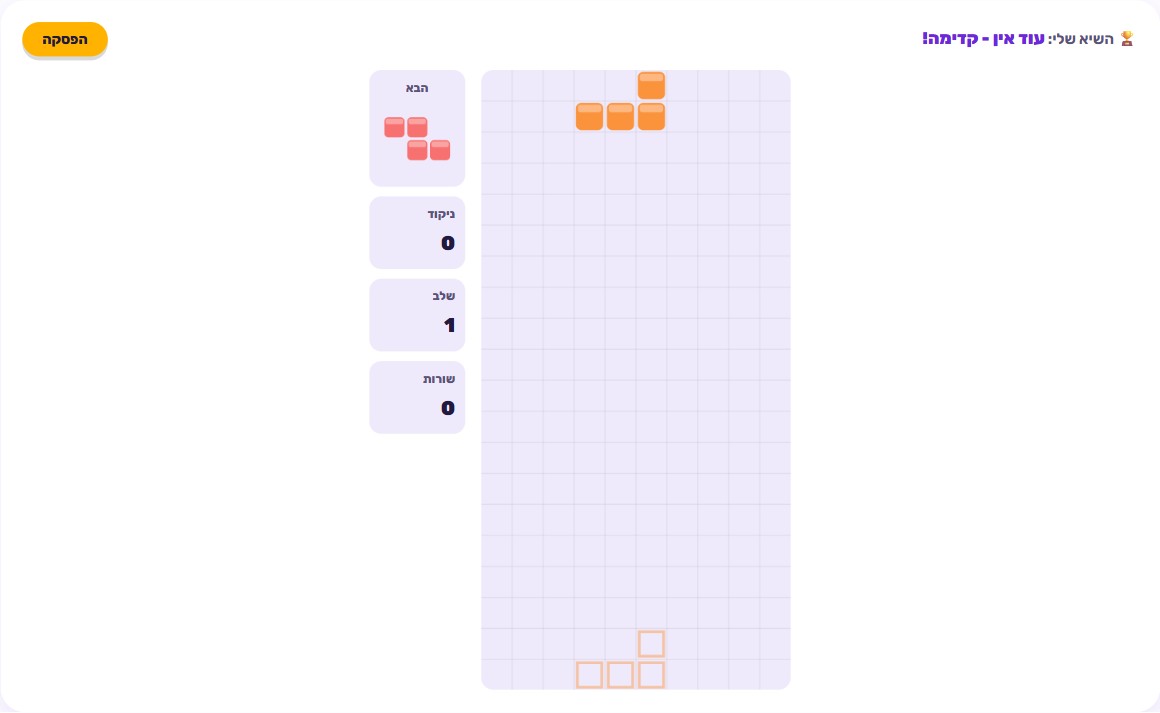
🎯 How to play
- Use the left and right arrow keys to slide the falling piece across the board.
- Press the up arrow to rotate the piece, including a small automatic wall-kick nudge if it's stuck against the edge.
- Watch the ghost piece - a transparent outline that shows exactly where the piece will land if you drop it right now.
- Press down for a faster soft drop, or space for an instant hard drop that scores more points.
- Fill an entire row edge to edge to clear it and bank the points.
- Keep playing as the speed climbs level by level - the game only ends when the stack reaches the top and there's no room to spawn a new piece.
The real history of Tetris
Tetris is one of the most famous, most recognized, and best-selling video games in history, and its origin is a world away from today’s colorful screens. It was created in 1984 by Alexey Pajitnov, a Soviet software engineer working at the Dorodnicyn Computing Centre of the Soviet Academy of Sciences in Moscow. The idea was disarmingly simple yet brilliant: seven distinct shapes, each built from exactly four squares - hence “tetromino,” and hence the name “Tetris” itself - fall one after another into a rectangular well, and the player has to arrange them so they complete full rows.
The game spread outside the Soviet Union in an unusually complicated way, and around it grew one of the most famous and tangled licensing histories in the entire games industry - a long tug-of-war between several software companies racing to release official versions for home computers, consoles, and handhelds. The moment that truly turned Tetris into a global phenomenon was its release bundled with Nintendo’s Game Boy in 1989, a pairing that made it one of the best-selling games ever made and turned it into a cultural icon that almost everyone recognizes on sight, even people who never played it themselves.
New official versions of Tetris are still released today on essentially every gaming platform, and competitive Tetris tournaments - including an annual world championship - still draw serious audiences who follow players pushing the game at nearly superhuman speeds. Nearly forty years after its original release, Tetris is still considered one of the most polished and well-balanced puzzle games ever designed, and that same balance is exactly what this free browser version is built on.
The 7-bag system - how the game stays fair
Anyone who knows Tetris well knows its fairness comes down mostly to how the next piece gets picked. In older versions of the game, each new piece was chosen completely at random out of all seven possibilities every single time - and that occasionally produced what players call a “drought,” for example going dozens of drops without ever seeing the long straight piece (the I-piece), right when you desperately needed it to escape a bad situation.
The fix that every modern official Tetris release eventually settled on is called the 7-bag randomizer, and it’s exactly the system running in this game too. The idea is simple and elegant: the game packs all seven possible shapes - I, O, T, S, Z, J, and L - into a single “bag,” shuffles their order completely at random, and then deals them out one at a time from that bag. The result is that every one of the seven shapes is guaranteed to appear exactly once before the game starts a fresh bag and deals out all seven again.
The practical effect: you’ll never wait an unreasonably long time for the specific piece you need to dig out of a tough spot, while the order within each bag still stays surprising and unpredictable. That balance between statistical fairness and genuine randomness is exactly why the 7-bag system became the unwritten standard every serious Tetris implementation follows, and it’s why this game still feels fair even in moments when luck seems to be against you.
Scoring, levels, and speed - how it works here
This game’s board is a classic 10-column by 20-row grid - the exact dimensions familiar from official Tetris releases. Points come from a few sources: every cell a piece travels during a soft drop earns 1 point, and every cell it travels during a hard drop earns 2 points - meaning a hard drop is both the faster way to play and the more rewarding one in score, as long as you’re confident about where the piece should land.
The real scoring, though, comes from clearing lines, and it uses the classic scoring table familiar from every Tetris game: clearing a single line is worth 40 points, clearing two lines at once is worth 100, three lines is worth 300, and four lines at once - a real Tetris - is worth 1200. Every one of those numbers gets multiplied by your current level, so the exact same line clear is worth far more at a high level than it was back at level 1.
Your level itself is calculated directly from the total number of lines you’ve cleared so far: level equals total lines divided by 10 (always rounded down), plus 1. You start at level 1, reach level 2 after 10 lines, level 3 after 20 lines, and so on. Every new level makes pieces fall faster, down to a minimum of 90 milliseconds per drop at the highest levels - a pace that demands genuinely fast reflexes. There’s no lives system and no countdown timer chasing you - the game simply continues uninterrupted, and it only ends the moment the stack gets too tall and there’s no room left to spawn a new piece at the top of the board.
What counts as a real Tetris - clearing 4 lines at once
The name “Tetris,” as it’s known today by almost everyone, refers specifically to the single most sought-after and most rewarding move in the entire game: clearing four full rows with one piece drop. Pulling it off usually requires leaving one column empty along the side of the stack and patiently waiting for the long, straight I-piece to arrive and complete all four rows at once - a technique known among Tetris players as “well-based stacking.”
In this game, that moment doesn’t pass quietly: clearing four lines at once triggers a special on-screen toast message together with a celebratory confetti animation - a small visual reward that matches the size of the achievement, since it’s also the single highest-scoring move on the entire table, worth 1200 points times your current level. Experienced players deliberately aim for this move instead of clearing rows one at a time whenever possible, since over a full game it multiplies their score far more than clearing single lines ever could.
Real strategy tips to beat your best score
- Keep your stack flat and even, not tall and uneven. A stack with tall towers in the middle and deep holes on the sides is the surest recipe for an early game over. Try to fill every row as evenly as possible instead of racing to build straight up.
- Deliberately leave one column empty for a real Tetris. This is exactly the well-based stacking technique above: fill the other nine columns and keep one column reserved and empty, so when the long I-piece finally shows up, you can drop it in and clear four lines at once instead of one at a time.
- Always check the ghost piece before you commit to a drop. It shows you precisely and reliably where the piece will land if you drop it right now, so there’s no need to guess - it’s the single most useful tool in the game for planning an exact move.
- Use a hard drop the moment you’re confident about placement. It’s not just faster - it’s also worth more points (2 per cell instead of 1), so it pays to get comfortable using it instead of always easing pieces down slowly.
- Plan ahead using the next piece preview, not just the current one. Since the 7-bag system guarantees every shape arrives within a reasonable window, you can prepare space for the upcoming piece before it even reaches the board.
- Don’t be afraid to rotate more than once. The wall-kick mechanic automatically nudges a piece slightly to the side when it would otherwise get stuck rotating near an edge or the stack, so it’s safe to try rotating even in tight spots.
Similar games on the site worth trying
If you enjoyed the mix of fast thinking and spatial planning in Tetris, check out 2048 - a number-merging game that challenges you to plan several moves ahead, just like Tetris, but on a grid of numbers instead of falling shapes. If you like real-time speed and quick reflexes, Cube Runner carries that same reaction-speed challenge into a fast-moving 3D world. And if you’d rather have a quieter spatial-arrangement challenge with no time pressure at all, Sliding Puzzle is a great pick that trains exactly the kind of spatial thinking Tetris also demands.
🧠 Test Yourself
Answer all three questions correctly to earn 100 stars!
Frequently Asked Questions
What actually counts as a 'Tetris' - a 4-line clear?
The name Tetris refers to the single most valuable move in the game: clearing 4 full rows with one piece drop. Pulling it off triggers a special on-screen toast plus a confetti animation, and it scores the highest amount on the table - 1200 points times your current level.
How do levels and speed work in this Tetris game?
Your level is calculated from total lines cleared: level equals (total lines divided by 10, rounded down) plus 1. So you hit level 2 after 10 lines, level 3 after 20, and so on. Every new level makes pieces fall faster, down to a minimum of 90 milliseconds per drop at the highest levels.
Is there a free version of tetris online with no download?
Yes. This game is completely free, runs right in your browser, and needs no sign-up, no app install, and no payment.
What is the '7-bag' system mentioned in classic tetris?
It's the fairness system every modern official Tetris game uses, including this one: all seven piece shapes are dealt once each in every 'bag' before a new bag starts, so you're never stuck waiting too long for the piece you need.
Is a hard drop actually better than a soft drop?
Both score points, but at different rates: a soft drop earns 1 point per cell the piece travels, while a hard drop earns 2 points per cell - so a hard drop is both faster to play and worth more points once you're sure where the piece should land.