
🃏
Hungry Animals: Reflex Game Guide
Hungry Animals is a fast whack-a-mole game: tap food before it disappears from 9 holes in 30-second rounds, feeding animals from cow to dragon.
▶️ Play Now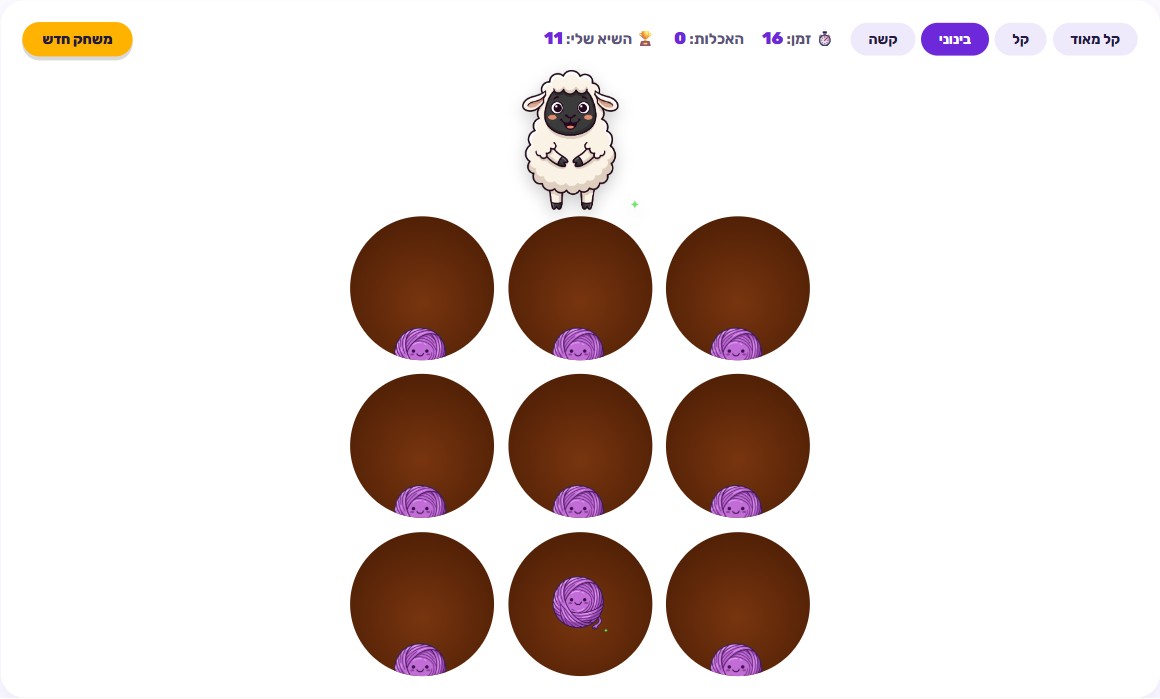
🎯 How to play
- Pick a difficulty level - Very Easy, Easy, Medium, or Hard.
- Watch all nine holes on the board - food pops out of them with no warning.
- Click or tap the food before it disappears back into its hole.
- Reach the hit target for the current level (6, 10, 14, or 18) to "feed" the current animal.
- Once an animal is fed, the game moves on to the next one in the cycle: cow, sheep, unicorn, penguin, dragon.
- Complete a full lap through all five animals and back to cow to unlock the "Hungry Champion" avatar.
What is Hungry Animals and how do you play
Hungry Animals is a simple, addictive reflex game: food pops out of nine holes on the screen, and you have to click or tap it before it disappears back down. There are no complicated rules and no long instructions to read - just fast reactions. Every round lasts exactly 30 seconds, and that clock is what makes the game so gripping: there’s no time to overthink, only to grab every piece of food as it appears.
The game belongs to the classic whack-a-mole family, but with a twist that gives it a clear goal: instead of just racking up points until time runs out, every hit feeds a real animal character waiting at the side of the screen. Once that animal has had enough food, it’s full - and the turn passes to the next animal in line.
Nine holes and a 30-second clock
The board is deliberately simple: nine holes spread across the screen, and each time food pops out of one of them with no warning. You never know in advance where the next item will come from, so you have to watch the whole board rather than just one spot. The moment food appears there’s a short window to click it - miss it, and it disappears back into its hole without scoring.
The 30-second clock runs in the background for the entire round, without pauses. That keeps every round tight and focused: there’s no “breathing room” like in slower strategy games, which is exactly why games like this fit so well into a short burst of play - a few minutes and no more.
Four difficulty levels, four different paces
Hungry Animals has four difficulty levels: Very Easy, Easy, Medium, and Hard. Each level differs along two dimensions that shape how a round feels:
- Spawn speed - on Very Easy, food appears relatively slowly and stays visible longer, giving you a comfortable reaction window. On Hard, the pace is much faster, and items appear and vanish so quickly there’s no time to “think” - only to react on instinct.
- Points per hit - the harder the level, the more each individual hit is worth. That makes sense: it’s harder to hit food that disappears fast, so the payoff for each hit is bigger.
Beyond pace and scoring, every level also has its own hit target needed to “win” the round and move on: 6 hits on Very Easy, 10 on Easy, 14 on Medium, and 18 on Hard. In other words, on Hard mode every single hit is harder to land, and you also need a lot more of them to progress. That’s what makes Hard a genuine challenge even for someone who’s already played the game a few times.
The number of stars you earn at the end of a round is simply the number of hits multiplied by that level’s points-per-hit value - so a player who clears the hit target on Hard earns noticeably more stars than someone doing the same thing on Easy.
The animal cycle: real progress, not the same round on repeat
What sets Hungry Animals apart from an ordinary whack-a-mole game is the animal cycle. Instead of always feeding the same character, the order is fixed and clear: cow, then sheep, then unicorn, then penguin, then dragon - and once you finish the dragon, the cycle loops right back to the cow.
The moment an animal reaches its hit target, it’s full and the turn immediately passes to the next one on the list. In practice, that means the game never feels like the same round repeating itself, because every few dozen seconds a new character with its own personality is waiting for you. It’s a simple but effective way to build a sense of progress without actually changing any game rule - the pace, scoring, and target all still depend only on the difficulty you picked, but the character in front of you keeps changing.
Anyone who completes the full cycle - feeding all five animals in sequence and looping back to the cow a second time - unlocks the “Hungry Champion” avatar, a permanent reward that stays with you after the game ends. It’s a clear goal that also works well for players who’ve already played several rounds and want another reason to come back.
Why fast reflex games like this are so popular
Whack-a-mole style games are among the oldest and most popular reflex games in the world, and not by accident. They’re built on one simple mechanic - react quickly to a visual cue - that anyone understands within seconds, with no explanation needed. There are no long rules to read and no complex strategy to learn: you see food, you tap it. That accessibility is exactly what makes games like this work for every age.
Beyond the immediate fun, games like this build real skills too: they train hand-eye coordination, the ability to translate what you see into a precise, fast movement of a finger or mouse. That’s a skill that improves with practice, just like any other motor skill. They also train quick decision-making under time pressure - every hit is a tiny decision you have to make in a split second, with no time to hesitate. That’s a useful ability that extends well beyond the game itself.
Because each round is short (just 30 seconds) and clearly defined from start to finish, the game is also especially well-suited to kids who struggle to focus for long stretches - there’s no task that drags on for many minutes, just a short, clear burst with a defined beginning and end.
Real tips for a higher score
- Watch the whole board with peripheral vision, not just one hole. The most common mistake new players make is staring at a single hole and waiting there. But food can pop out of any of the nine holes with no warning - strong players keep their eyes on the center of the board and use peripheral vision to catch movement anywhere, then move their gaze or finger to the right spot only once something appears.
- Stay relaxed instead of tensing up. It sounds counterintuitive in a game that’s all about speed, but excess muscle tension actually slows down reaction time. Players who try to force themselves to react faster by tightening up tend to miss more, not less. A loose, quick movement beats a tense, hesitant one.
- Start on Very Easy or Easy to learn the rhythm. There’s no point jumping straight into Hard - the pace there is so fast that without prior familiarity with the game, it’s genuinely hard to know where to look. A few rounds on the easier levels build a feel for where food tends to “pop up” and make the jump to Hard feel much more natural.
- Keep the current hit target in mind. 6, 10, 14, or 18 - knowing exactly how many hits are left for the current animal helps you stay focused and paced instead of guessing when it’ll be full.
- Don’t spread your attention across every hole at once. Instead of trying to “cover” all nine holes in parallel, it’s more effective to focus attention on the center of the board and let motion at the edges pull your eye - that’s faster in practice than scanning hole by hole in a fixed order.
- Play several rounds in a row to build muscle memory. Just like with any reflex game, the more you play, the more your fingers “learn” the rhythm without conscious effort - that’s a natural process that comes with repetition, not something you can shortcut just by reading about it.
A newer page on this site
This page is still relatively new on the site, and we don’t yet have measured search data for “hungry animals game” the way older, more established games on the site do. That doesn’t make the game any less worth playing - it just means it’s younger, and we’re describing it honestly for what it actually is: a reflex game about feeding animals, nothing more and nothing less.
Similar games on the site worth trying
If you enjoyed the fast pace of Hungry Animals, check out Hungry Hippos - another game that’s all about grabbing food quickly, but with a completely different mechanic. If you like reacting fast to an unpredictable cue, Whack-a-Mole is the direct ancestor of this whole genre. And if you want a different kind of reflex challenge - continuous reaction instead of single bursts of clicking - Snake is a classic, perfect fit.
🧠 Test Yourself
Answer all three questions correctly to earn 100 stars!
Frequently Asked Questions
What are the four difficulty levels in Hungry Animals?
Very Easy, Easy, Medium, and Hard. Each level differs in how fast food spawns, how many points each hit is worth, and the hit target needed to move on: 6, 10, 14, and 18 hits respectively.
How does the animal cycle work?
You feed one animal at a time in a fixed order - cow, sheep, unicorn, penguin, dragon. Once an animal reaches its hit target, the game immediately moves on to the next one. After the dragon, the cycle loops back to the cow.
What does it take to unlock the Hungry Champion avatar?
You need to complete a full cycle - feed all five animals in sequence and loop back to the cow. It isn't tied to a specific difficulty; it's about finishing the whole lap.
How long does each round last?
Every round lasts exactly 30 seconds. The clock runs continuously for the whole round, with no breaks along the way.