
🃏
Shofar Game Guide: Sounds & How to Play
The Shofar Game: hold to blow tekiah, shevarim, teruah, or tekiah gedolah. Learn all four sounds, three difficulty levels, and Rosh Hashanah sequences.
▶️ Play Now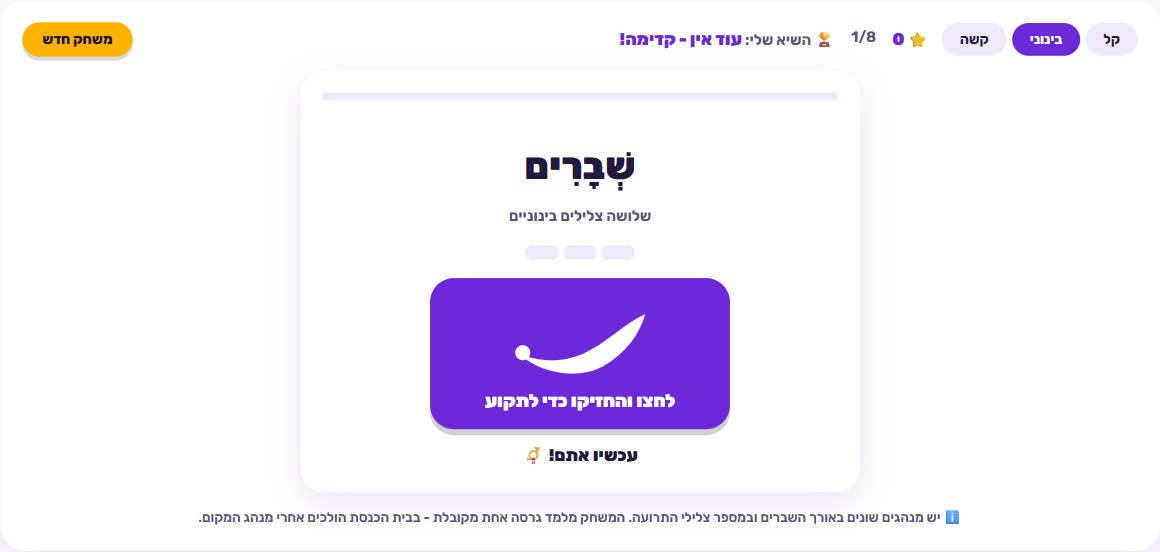
🎯 How to play
- Press and hold the shofar button to blow - how long you hold sets how long the blast is.
- Check the block pattern shown on screen - it shows exactly which sound is being asked for: tekiah, shevarim, teruah, or tekiah gedolah.
- For tekiah: press and hold once, in one long, steady blast. For shevarim: release and press again three times in a row, each a medium length.
- For teruah: release and press again rapidly, several times in a row - the game accepts anywhere from 5 to 14 short presses as a valid teruah.
- Easy mode plays a demo of the requested sound before each try. Medium and Hard skip the demo - you rely on the visual pattern alone.
- Hard mode asks for a full real sequence - tashrat, tashat, or tarat - just like the ones sounded in the Rosh Hashanah service.
What is shofar blowing, exactly
A shofar is a hollowed-out ram’s horn (or another kosher horn), open at both ends, and every sound it makes depends entirely on how it’s blown - how hard, how long, and in what pattern. It isn’t a melody instrument; it’s a breath instrument, and the whole “vocabulary” of the shofar comes from the shape of the blast, not from pitch or tune. In Jewish tradition, the shofar is blown mainly on Rosh Hashanah, as a central part of the holiday service, and it’s also customary in many communities to blow it daily throughout the month of Elul beforehand, as a lead-up and a call to reflection ahead of the new year. Shofar-blowing on Shabbat is a real point of Jewish law in its own right: when Rosh Hashanah falls on Shabbat, many communities don’t blow the shofar that day and complete the blowing the next day instead. This game doesn’t replace any of that - it’s built to teach, clearly and accurately, exactly what each of the sounds the tradition asks for actually sounds like, and to let kids (and parents) practice recognizing them without pressure and without needing a real shofar on hand.
One thing worth clarifying up front: this is a browser game to play, not an audio file to download. If you searched for a shofar recording to save, this isn’t that. But if you want to understand, practice, and genuinely recognize the sounds themselves, that’s exactly what this game is built for.
Four sounds, four meanings
The game asks you to produce four kinds of sound, and each one has a precise, well-defined shape in tradition:
Tekiah - one single, steady, unbroken blast. It’s the “whole” sound of the four.
Shevarim - three medium-length blasts in a row, each shorter than a tekiah but longer than the short bursts of a teruah. The name itself means “broken pieces,” hinting at a sound that isn’t smooth or uniform.
Teruah - a rapid series of very short blasts, much faster than shevarim. In the game, any run of 5 to 14 short presses in quick succession counts as a valid teruah - a reasonable range that doesn’t demand millisecond precision.
Tekiah gedolah - exactly like tekiah, but held for an especially long time. It’s usually the sound that closes a full sequence, and anyone blowing it in synagogue typically tries to hold it as long as they can.
Important: the game doesn’t check millisecond timing. It checks the shape of what you blew - how long you held, and how many times you pressed - the same way a listener recognizes tekiah from shevarim by the overall shape of the sound, not with a stopwatch.
Why these specific sounds - the traditional explanation
There’s a well-known, widely-taught explanation for why these three sound types - tekiah, shevarim, and teruah - sound the way they do. Tekiah, the steady, unbroken blast, represents wholeness: one clear tone, with no break in it. Shevarim and teruah, by contrast, are traditionally understood to evoke a crying sound - shevarim like a broken sigh, and teruah like a rapid, short sobbing. The order the sounds appear in - tekiah, then a broken sound, then tekiah again - is meant to trace a movement: from wholeness, through brokenness and awakening, and back to wholeness. That’s exactly why there’s real value in learning to recognize each sound individually, rather than just “hearing a shofar” without noticing the differences - and that’s precisely what this game trains.
Beyond the conceptual side, there’s also a genuinely precise legal (halachic) dimension to all of this: traditional sources are careful about the exact definition of each sound - how long, how short, how many repetitions - which is why practicing accurate sound recognition isn’t just a pleasant ear exercise, but a real part of preparing for accurate, quality shofar blowing.
How to play: press, hold, release
Mechanically, the game is simple: there’s one shofar button, and you press and hold it. How long you hold it is exactly how long the resulting blast is. Releasing and pressing again creates a separate, new blast. That’s all you need to produce every one of the four sound types:
- For tekiah or tekiah gedolah: one continuous press-and-hold. The only difference between them is how long you hold it - tekiah gedolah needs a longer hold.
- For shevarim: three separate press-and-hold actions, each a medium length, one after another.
- For teruah: many very short presses in rapid succession - anywhere from 5 to 14 counted presses registers as a valid teruah.
The sound itself can either be synthesized right in the browser or played from a real recorded audio file, depending on settings - but either way, alongside the sound, a visual block pattern is also shown on screen, indicating exactly how many blocks and how long each one should be. That means you can play the whole game without relying on your ears at all - the visual pattern alone is enough to know what to do.
Three difficulty levels - from beginner to tashrat
Easy - 6 rounds, and before every attempt the game plays a demo of the requested sound. This is the best starting point for anyone who doesn’t yet know the difference between the sounds by ear - you hear it first, then try to reproduce it.
Medium - 8 rounds, with no demo beforehand. Here you need to identify, from the name or the visual pattern alone, which sound is being requested and produce it correctly.
Hard - only 4 rounds, but each round isn’t a single sound - it’s a complete, real sequence, exactly as blown in synagogue on Rosh Hashanah:
- Tashrat - tekiah, shevarim, teruah, tekiah.
- Tashat - tekiah, shevarim, tekiah.
- Tarat - tekiah, teruah, tekiah.
These are the genuine, traditional sequences - not something invented for the game - and completing Hard mode, even without a flawless run, unlocks the “Shofar Champion” avatar. You don’t need a mistake-free run for it - just finishing all 4 rounds of Hard difficulty is enough.
Real tips for playing well
- Look at the block pattern before you press anything. Especially on Medium and Hard, where there’s no audio demo, the visual pattern is your most reliable source for what’s being asked - how many blocks, and how long each one is.
- Practice the feel of a long tekiah versus an extra-long tekiah gedolah. The only difference between them is hold duration - getting a physical feel for what counts as “long” versus “extra long” speeds up your improvement fast.
- For shevarim and teruah, your finger matters more than your ear. These are multi-press sounds, so the rhythm of your presses and releases matters more than anything else - try to keep an even beat between presses.
- On Hard mode, don’t try to memorize the whole sequence at once. Tashrat is four separate sounds - it’s easier to go sound-by-sound following the visual pattern than to try to memorize the entire sequence in advance.
- Start on Easy even if you already know the shofar from synagogue. The demo before each attempt helps connect what you’ve heard before to exactly what the game is asking for, before jumping into levels with no demo at all.
- If something’s unclear, pause on the visual pattern for a moment. There’s no countdown pressuring you to press before you look - a moment of attention saves a lot of failed attempts.
You can play it without sound too
One of the nicer features of this game is that it doesn’t depend on hearing. Every requested sound is also shown as a clear block pattern on screen - the number of blocks and their length show exactly which sound is being asked for, with no dependence on listening at all. That’s useful not just in a quiet place (like a classroom or library), but simply as another way to understand the structure of each sound: seeing visually that shevarim is three medium chunks, while teruah is many short ones, helps the difference sink in even better than hearing alone.
Similar games on the site worth trying
If you enjoyed the Jewish-educational angle of blowing the shofar, you’ll also like Which Blessing? - a game where you see a food and pick the correct blessing to say over it, with an explanation after every answer. Anyone interested in more content tied to the Holy Temple and Jewish tradition will enjoy Build the Temple, where you build one vessel at a time and learn a fact about each one. And for another sourced, accurate trivia challenge, Mishnah Quiz tests knowledge of Mishnah tractate Rosh Hashanah, with a sourced explanation after every question.
🧠 Test Yourself
Answer all three questions correctly to earn 100 stars!
Frequently Asked Questions
What's the difference between tekiah, shevarim, teruah, and tekiah gedolah?
Tekiah is one long, unbroken blast. Shevarim is three medium-length blasts in a row. Teruah is a rapid series of short staccato blasts (the game accepts 5 to 14 short presses as valid). Tekiah gedolah is one extra-long blast, usually used to close a sequence.
What are tashrat, tashat, and tarat on Hard mode?
These are the genuine, traditional sequences used when blowing the shofar on Rosh Hashanah. Tashrat is tekiah-shevarim-teruah-tekiah, tashat is tekiah-shevarim-tekiah, and tarat is tekiah-teruah-tekiah. Hard mode asks you to produce each full sequence, the same way it's sounded in synagogue.
Can I play without sound, or in a quiet room?
Yes. Every requested sound is also shown as a visual block pattern - how many blocks, and how long each one is - so you always know exactly what's being asked for even without relying on audio.
How many difficulty levels are there, and what's the difference?
Three. Easy has 6 rounds and plays a demo of the requested sound before every try. Medium has 8 rounds with no demo. Hard has only 4 rounds, but each round is a complete real sequence - tashrat, tashat, or tarat.
How do I unlock the Shofar Champion avatar?
Just by finishing Hard mode. It doesn't need to be a perfect, mistake-free run - simply completing all 4 rounds of Hard difficulty unlocks it.